Erraid is made of some of the oldest rock on earth. For 420 million years it has hosted multiple ice ages, temperate forests and intermediate eons. Look around at the near islands and they all show their age; Staffa, Little Colonsay and the Treshnish isles all demonstrate the flattening out of time, tides and temperatures. ‘It won’t be long,’ you think, ‘until they are worn to a flat disk and then, plop, in they’ll go.’
Pioneer fauna wants to get a grip, but any surface of more than a 30 degree incline is bare. The plants simply can’t hold on; the surface too smooth and lacking the semi-permeable pocks and crevices of limestone or chalk. Where the rock relents, in the bowl of the mid-isle, the peat is thick; bog water the colour of stewed tea. After hard rain, the sea turns from clear to brown until the tide takes it out again.
In stark contrast Balfour bay is a fine, white sand beach and, a few miles around the east coast of Mull, there is the Black sand beach of Carsaig.
Human habitation can be traced back as far as 2500bc and the Beaker people, travelling north from the Rhineland. Later, Celts from Ireland, Picts, Vikings and Saxons, until the Scottish clans of Campbell, MacLean and MacDonald settled in to a steady rhythm of internecine sacking and massacring; and agriculture when it was quiet.
After countless shipwrecks off the Ross of Mull (24 in the year spanning 1865-66, at the cost of 21 lives), the Northern Lighthouse board proposed that a lighthouse be built on a rock 17 miles out to sea, due south of Erraid, called Dubh Artach. They engaged the company of David and Thomas Stevenson who had already built up an impressive portfolio of lighthouses in hard-to-reach places. Erraid was decided as the construction base and was therefore changed from an uninhabited outcrop to a major construction site. Thomas Stevenson brought his son along for a few extended visits. Later, Robert Louis was to use the landscape of Erraid in his books ‘The Merry Men’ and ‘Kidnapped’, Balfour Bay being named after David Balfour, the hero of the latter.
A broad pier was constructed, along with a boat house and a street of cottages for the construction workers and their families. These would later turn into the lighthouse keepers cottages and, much later, the cottages lived in by us and visited by people from all over.
Stone was quarried from 50 meters south of the pier, cut and dressed to precise measurements and then dovetailed so all pieces interlocked. No mortar was used between any stone on the lighthouse. During construction the conditions were a constant problem, so that it was only possible to land on Dubh Artach occasionally. Prior to starting the build a cast iron domed structure was build on stilts and riveted to the rock on Dubh Artach. This was barracks for the workers. During one particularly bad storm 14 men were trapped for six days as torrents battered the outcrop and their metal shell, the sea breaching it on one occasion and washing away vital supplies of food. One can only imagine the desperate conditions during that prevailed.
Victorian engineering such as this is barely fathomable. They dragged 2 ton granite blocks up a completely smooth rock far out to sea using hand winches, as the spray washed over, with nowhere to retreat to but an iron box! The lighthouse took 4 years to complete as, during that time, landing was only possible a total of 91 days. 3115 tones of rock were transferred and placed on those days. Just as the world was enthralled when Thor Hayerdahl and his crew set off over the pacific ocean in a raft to prove a point about early seafaring, so too I am disarmed by the sheer audacity of the idea, let alone the execution of it. Self-regard ignored in pursuit of a nobler aim.)
It seems, remarkably, no one lost their lives during the construction. There were injuries reported, mostly body parts being hit or crushed by heavy stone. They all came back after a time to the cottages of the street, with their heavy doors and large, open fires of coal, to dry off, rest and sleep, in the knowledge that soon, when the sea granted permission, they would be out, at it again.
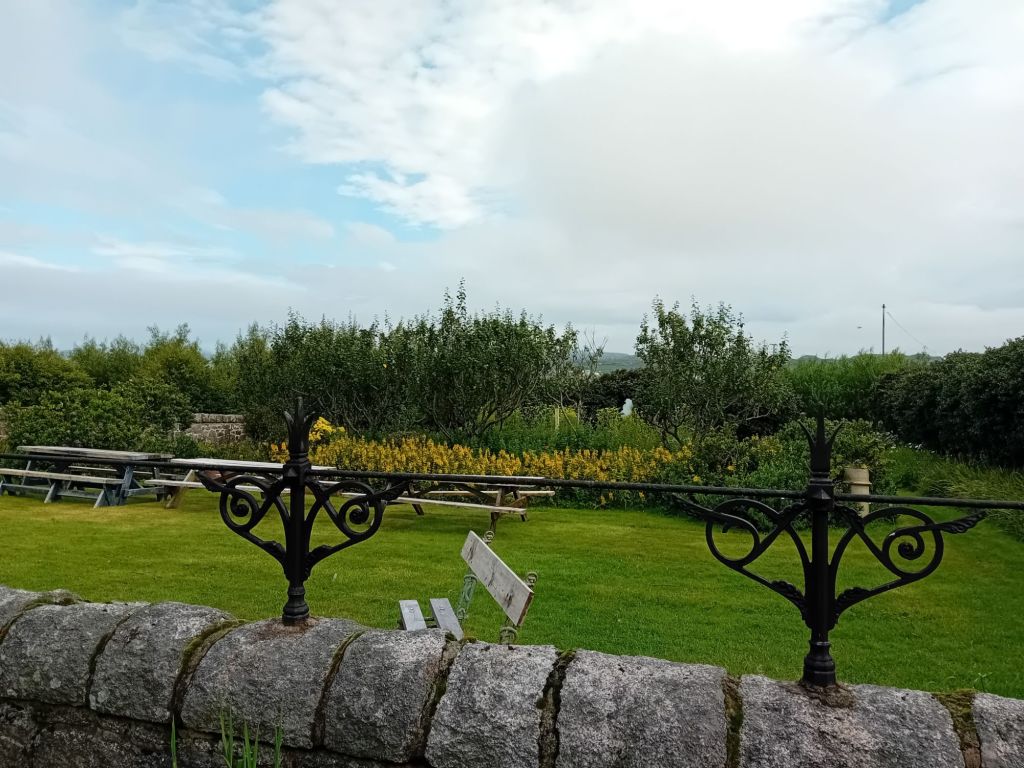
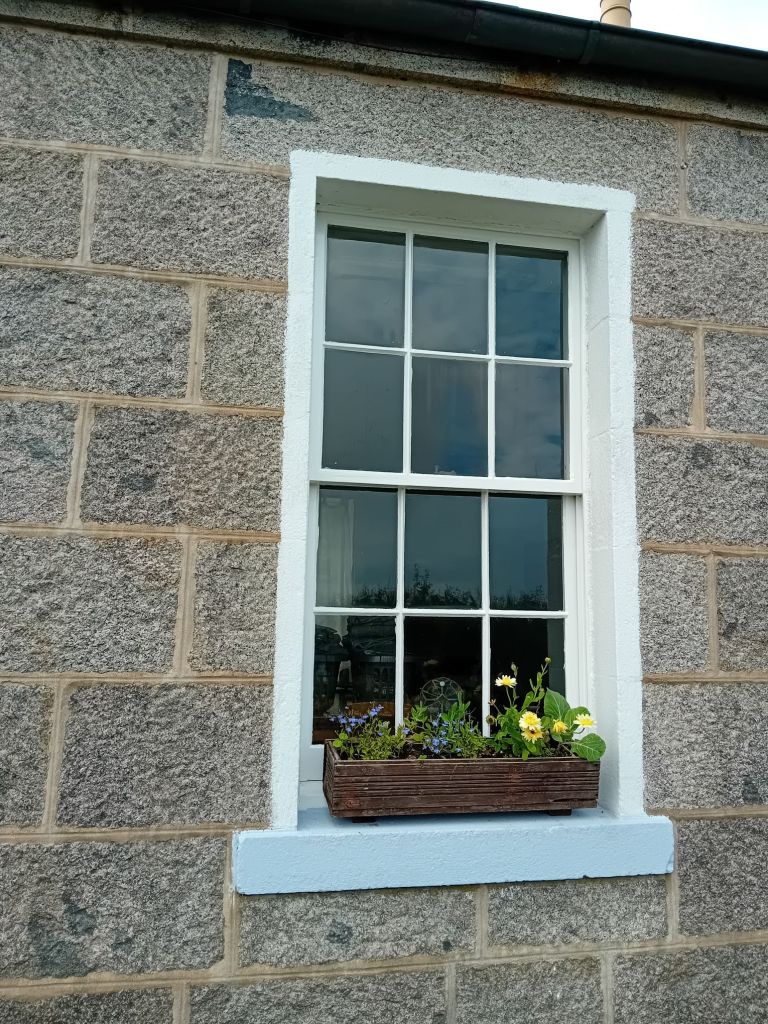
The houses are semi detached, single story cottages, built of the same slivery grey/black as the lighthouse. There are heavy, hard wood doors with thick bolts to keep them shut. The windows are generous to the north and shrink towards the south, where the new kitchens and bathrooms are. The wide fireplaces that were once open still have huge clothes airers, hoisted on ropes, above them. Cottage number one used to be a school for the lighthouse builders and keepers children, and also for other local children that made their way across the narrows each day from the mainland. After lessons, the children would help in the gardens or any other domestic tasks. When they were done with that a fair few would be seen running around the perimeter walls that act as much-needed wind breaks for the crops.
 Erraid life
Leave a comment