Tag: family

  • On having no keys

    Two days before heading south for the summer, I thought it would be a good idea to see if the car would start.

    It did.

    However, when I pressed my foot to the accelerator, absolutely nothing happened.

    It was turning over like a dream, but the brakes were completely salted up — a common ailment for vehicles parked next to the sea.

    By means of a rhythmic rocking between first gear and reverse, the trusty, and increasingly rusty, Yaris finally eked forward, not without some resistance.

    Knowing the value of a good run before attempting the 500-mile journey to Stroud, I nursed it around the single-track road to Bunessan and then stopped for a Twix.

    On returning to the car, I noticed a rubbery smell and reflected that I’d had my foot firmly to the floor during the ten-minute trip and hadn’t broken 35 mph.

    Nevertheless, I fired her up once more. But now the smell was in my nostrils and genuine concern for my safety was creeping in… not a moment too soon, I hear you say!

    By the time Robin’s garage came into view, I was glad to have the opportunity to talk to someone who knows a thing or two about cars.

    Having described my predicament, Robin, well past retirement age and with a pronounced limp, shuffled round the car, placing his hands close to the tyres, as one might if performing reiki.

    “Feel that,” he offered, gesturing for me to put my hand around the area of the front driver’s-side wheel.

    “Not too close, mind.”

    I couldn’t get it closer than 50 cm before the heat became too much.

    “You see the black smear around your brake disc?”

    I nodded foolishly.

    “That’s your brake pad melted.”

    It was at this point that the folly of driving 500 miles came into sharp focus.

    Considering the sizeable bill from the last MOT and the infrequency of use, I made a decision to let her go.

    Reverting to public transport takes planning and sanguinity. From Erraid, there are, utilising the “most efficient/cheapest” coefficient, eight different legs to get to Stroud.

    The upside: plenty of time for reading and taking in the views.

    The downside: a man vomiting into his own lap in the seat behind me half an hour into the coach journey from Glasgow to Birmingham.

    As I was slumped in a metal chair, staring at Ozzy, the huge reclaimed-metal bull in New Street Station, I realised I had achieved a life goal:

    I have no keys.

    During a time of managerial responsibility at school, I had so many keys I had to have a keyring hanging off another keyring.

    After a small mental-health event, I decided to simplify life, and the shedding of keys seemed a good yardstick. Not the only one, but symbolic, at least.

    In Italy, we never locked the doors of our little apartments at the top of the hill, but there was still the trusty Yaris and the school that kept my pockets a-jangle.

    Erraid is a place with few locks. The ones on the bathrooms are the only ones I can think of.

    There are no places that are out of bounds, although guests are discouraged from spending time in the chainsaw shed.

    My personal effects are either too old or dirty to be of interest to even the most ardent kleptomaniac, should such a person decide that a week’s retreat on Erraid would be just the thing.

    In the end, though, having no keys points to there being less to think about, which is fine by me.

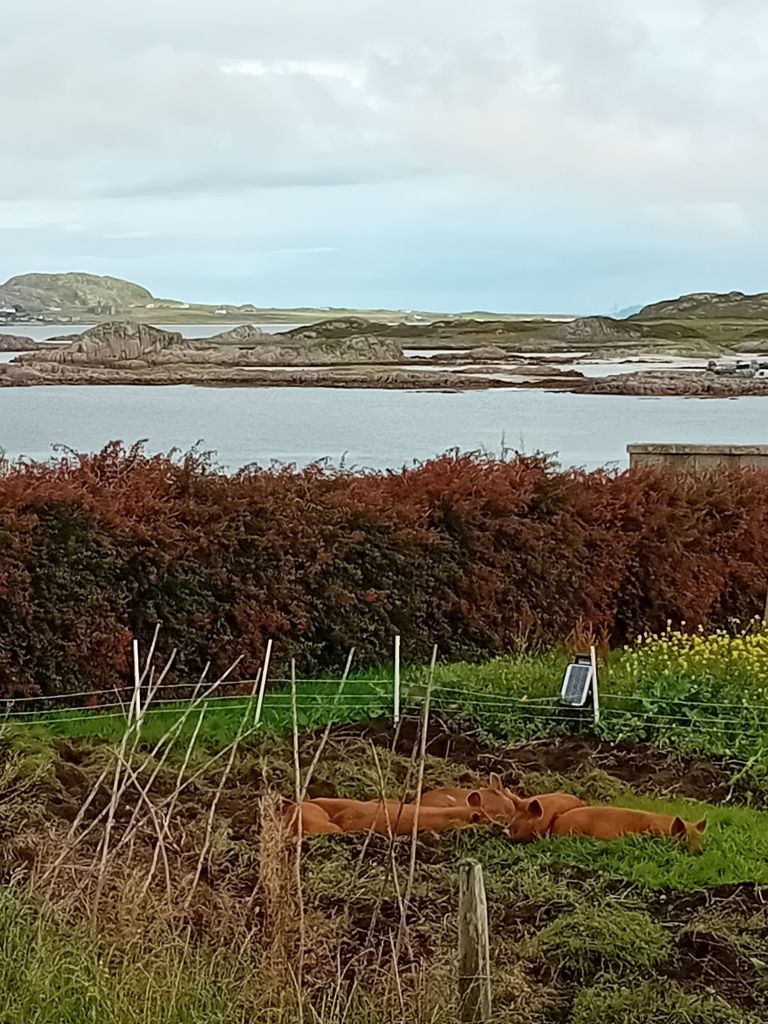
    I enjoy using the freed-up space talking to the pigs!
  • Amy

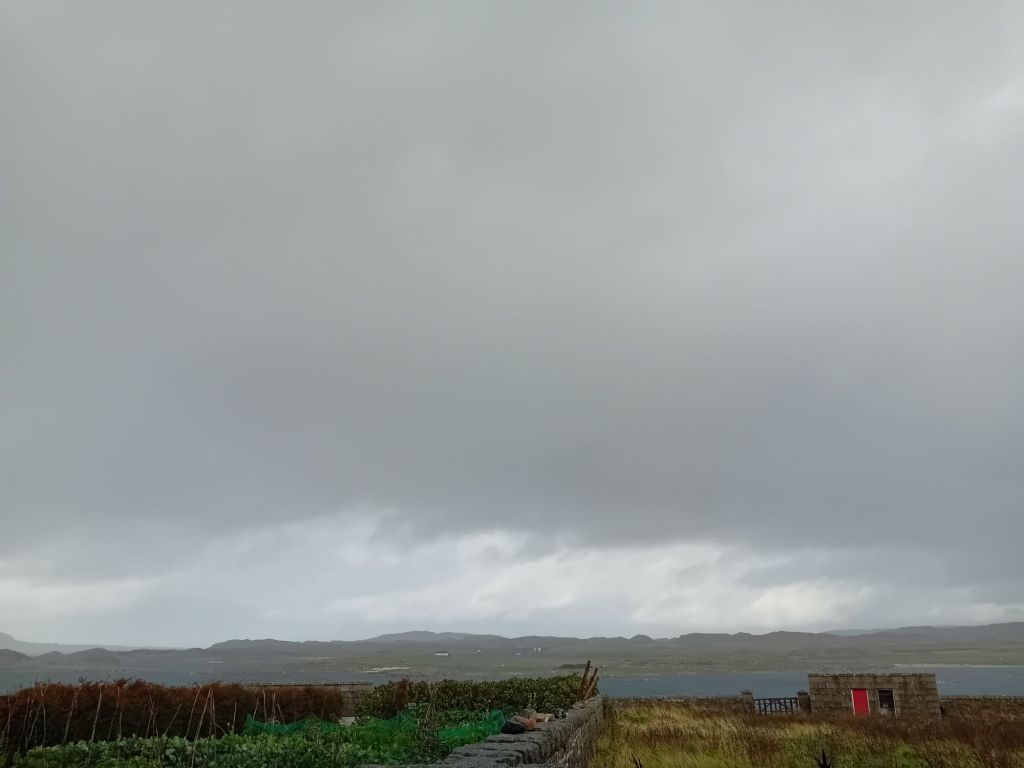
    She arrived on Friday afternoon, whipping the normally dainty waves of the inlet into feisty froth. By 9 p.m. the wind had reached 95 mph, and the power was gone. All Saturday she tore at the gardens and rattled the more fragile gates clean off their hinges. Gaps under doors and in the frames of windows she ruthlessly exploited. Curtains were pulled, and chunky sock-filled snakes were thrown down to mitigate—but they were no match. Water seeped, then dripped freely from behind the chimney of Number 3. The flames in the fireplace danced violently as draughts found every cranny.

    We all crowded into Number 6 and placed lit candles around the room. It looked lovely, and we started chatting away excitedly, as though the pace of the wind had quickened our wits at the end of the day. To be sure, there were nerves too—from those who hadn’t seen the like before. This included me. We went to fetch the generator and watched the fuchsia bushes bent double at sixty degrees. The sunflowers in the kitchen garden had already fallen, as if kicked by a thoughtless lout. Coats slapped our thighs, stinging, and untied hood drawstrings flicked our eyes. No rain at that time, and mild.

    Alas, the cord on the generator dislodged, and with it our hopes of light, hot water, or sanitation. This, we learned smartly, was our introduction to the single-point-failure system we lived with. As the wood stoves heated our water, the water needed to move—otherwise it boiled in the pipes, and without the pump…

    Daylight on Saturday brought sights that could have been much worse, had it not been for the granite walls of the gardens and houses. Two of Judy’s trees at the croft were down, and her son Tom was reportedly spread-eagled on the roof of his house in the middle of the storm, trying to save his new solar panels from flying away. The purple kale and broccoli were flattened, but the polytunnels had come through unscathed. Amy hadn’t finished, though, and all through the day the winds were such that you had to really want or need to be out. Outdoor errands were brief scuttles to the communal kitchen, which became our natural meeting place as it had the only gas cooker on the island. Without any organisation, we coalesced for breakfast; porridge and coffee were made and shared as we reflected that the chances of receiving new guests were nil. Schedules went out of the still-shaking windows.

    We managed to get the generator going, and a timetable was drawn up so it could keep the freezers at temperature and, at other times, pump water for taps and loos. The compost toilets were very handy facilities, and you may never have a fresher comfort break.

    By Monday, Amy was legend, and the two guests who hadn’t cancelled were picked up and settled in. Power returned on Tuesday around 2 a.m. We were all in agreement that it had been a wonderful experience. The intimate softness of candlelight carried us into the evening with calm and sympathy for the dark outside; conversation became more introspective. There was no internet. I found myself habitually checking my phone in a pointless attempt to gain the dopamine hit I craved, before relaxing into a couple of hours with a head torch and The Steep Approach to Garbadale by Iain Banks (the first of his I’d read since being thrilled and terrified by The Wasp Factory in my early twenties).

    When the green light on the router finally came on, I was excited for all the things I’d missed. Had Nottingham Forest sacked another manager? Had people posted photos of things falling down? Granted, a few admin-type things had lapsed and needed attention, but that was all doable.

    Tuesday seemed like a good day to get things back to normal, so I pulled on my swimmers and headed down to the pier for a dip in the brown, soupy sea. I was halted by a power line lying idly on the ground, still connected on its unbroken end to the pylon. The electric company, deciding this was a decent emergency, had it back up within two hours—an amazing feat round our way.