Tag: hiking

  • A quiet stop over

    I had such a good time over the Christmas holidays. Three weeks of merry-making with friends and family left me revitalised and reminded me how lucky I am to be able to return to such riches.

    Among the old friends that came to visit was my continuing inability to moderate food and drink intake. Now, I’m not about to dive into the still-warm soup of January contrition. I was, however, looking forward to taking leave of such temptations and returning to the simple pleasures of island life on Erraid… with a night’s stopover in Glasgow.

    The idea was simple: find the Airbnb, have a shower, and collapse into what would hopefully be a comfy bed, maybe even with a TV.

    It was 5 pm and dark when I turned off the M8 into the city. Maps was behaving well and my eyes were smarting from seven hours behind the wheel. Turning into the road of my accommodation, it struck me as odd that, considering there were only eight houses to be seen among the medium-sized industrial units, I was looking for number 92.

    Doubling back, I drove more slowly up the poorly lit street, eventually identifying number 92 as one half of a large Georgian semi. Its looks belied its immediate environment. A wooden swing seat stood in front of the freshly painted white exterior, which almost glowed when the sensor light tripped. As if looking at a parasitic Siamese twin, I then noticed that the other half of the building had no upstairs windows, chipboard downstairs, and a metal grate for a front door.

    I also observed that, for a largely industrial street, there were few parking spots available. Finding one a few minutes’ walk from the Airbnb, I left my rucksack in the care of the rear-tinted windows of my car and sashayed back along the already freezing pavement.

    A large wooden Buddha smiled at me as I walked in, and the smell of curry leaves and coconut wafted from somewhere towards the rear. My room was huge, with a nice firm bed, fridge, kettle, and separate seating area—not bad for £36.

    Before collapsing onto the longed-for bed, I drew back the curtains to close the window, which was slightly ajar. It was then that I saw it. One street away, looming high and floodlit in the damp, frozen early evening, was Ibrox Stadium, home of Glasgow Rangers Football Club.

    Funny things happen to me when I am close to large stadiums. I get very excited and start to imagine what it must be like to be inside, with a full crowd cheering and singing away. Adrenaline starts to flow. But this was a Tuesday night—an unlikely evening for a match. Or so I thought.

    A man and his son sporting football scarves walked briskly along the street. Already feeling a weird sense of inevitability, I lowered myself into one of the faux-leather chairs provided and looked up the BBC Sport football fixtures page: Rangers v Aberdeen, 8 pm.

    What could be the harm in having half an hour’s rest and then wandering down just to soak up the atmosphere? I didn’t even manage that. More excited than I realised, I found myself putting my boots back on straight away and heading out the door.

    A police motorcyclist cruised past as I turned the corner. Already, at 5.30 pm, hundreds of supporters were standing in the chilly street chatting away. I made my way to where the buildings opened out, and there was the stadium, with its illuminated insignia and lovely old red-brick main stand.

    Before I knew what I was doing, I sidled over to an aged steward and asked if, in general terms—and for no specific purpose—Rangers sold tickets at the stadium on match days. (Not something you can do at Torino FC, as I found out a year or two ago.) The steward answered in the affirmative, and I was heading in the direction specified when I was stopped by two chaps who asked if I could take their photo.

    They were from Austria and were on a football holiday, starting with Rangers and finishing in Newcastle the following evening. Of course, they had a spare ticket.

    Such serendipitous occasions need to be celebrated, so we made our way to the Louden Bar—a bar which, for good reason, had no windows. On entering, it felt like being inside a massive Rangers shirt in a few different ways. Benny, Paul, and I chatted over popular ’80s hits and continued our conversation by shouting when various unionist anthems came on at double volume.

    It was one of those moments where one has to decide whether to silently mouth something that looks like the lyrics or to just carry on talking and hope that one’s continued presence is not contingent on knowing the chorus.

    After a couple of pints and handshakes all round, Benny and Paul went to soak up the pre-match atmosphere inside the ground.

    I decided to see what knowledge I could glean from the locals about the very mixed fortunes of their beloved club in recent years, which included going out of business entirely in 2012 and having to start again at the bottom of the Scottish league system.

    After an amiable but short exchange with an elderly season-ticket holder, I put my pint down on a table at the edge of the room and was greeted by a chirpy, slight, grinning woman.

    “A-right?”

    Jeanette introduced me to Davey, her stocky husband wearing a short-sleeved Rangers shirt, and Alan, their friend of over 400 matches. As soon as I confessed that I’d never been to Ibrox before, Alan immediately went to the bar and came back with another vodka Irn-Bru for Jeanette and a Tennent’s for Davey and me.

    This carried on for a while. Friends came to say hi. I was introduced to all of them. Two bought me pints, and all of them wished me a great evening and hoped that I would come back. I got the sense they really meant it.

    About twenty minutes before kick-off, we parted. I was told in no uncertain terms that I was to call them if I was ever up that way again.

    Moving towards the main stand in the throng, I was reminded that Ibrox is an alcohol-free stadium. They have got around this by building the biggest bar I’ve ever seen right next to the ground—essentially, a beer stadium.

    The game itself was a tepid affair, which Rangers won 2–0. I was disappointed to discover they had sold out of macaroni pies at half-time.

    My energy crashing fast, I left a couple of minutes before the final whistle. I managed to circumnavigate the stadium completely before finding my road and was very happy after that to capitulate into bed.

    At 1:13 am I was woken by a very loud, very close noise I couldn’t place. I lay there, too tired to get up and have a look, and instead tried to imagine what it could be.

    Was someone attempting to machine-gun the alphabet into a piece of corrugated iron? Perhaps a flange of baboons were fighting over one of those bass drums you get in marching bands. Or could it be that there were, after all, occasional residents in the dilapidated shell next door?

    Seeming to answer this question, the next time I woke was to the sound of someone being horribly, horribly ill on the street below my window at 6.30 am.

    I took this as my alarm call, had a quick shower, packed, skated over the ice past the IRA graffiti, found the nearest place serving coffee, and headed for Oban, for Erraid, and for a wee bit of calm.

  • Deluge

    ‘Water, water everywhere,
    And all the boards did shrink,
    Water, water everywhere,
    Nor any drop to drink.’

    The Rime of the Ancient Mariner, Coleridge

    There are new streams on either side of the road from Fionnphort to Knockvologan. They were not there yesterday and have sprung into life in mere hours. The tarred surface seems now more causeway than road. Ponds sit afresh on the fields by the sea. Even the sandy soil cannot drain away this much water. The grey geese are enjoying this new wonderland, sitting proudly afloat as if to confirm their decision to forgo their migration, full of risk and energy.

    Since the early morning there has been driving drizzle from the east that has saturated Mull and Erraid. The sky is a single sheet of grey that squeezes the tiny fleas of moisture, sending them jumping and skittering amongst each other until they finally settle on the ground — in the fleeces of sheep, on the flight feathers of angry storks, on the roofs of the scattered dwellings that ring the bay, and on the hoods and trousers of those who must be out. From all these places and more they gather strength and force, joining with countless others to charge down the hillsides, finding crevices from previous storms and forging new channels and thoroughfares — the quicker to make it to sea level. Pipes that run under the roads are nearly at capacity.

    It hasn’t felt like a downpour of any great magnitude, but the sheer thickness and persistence of the squally, misty rain has penetrated deep into the ground and worked its way up through the peaty marshes, unable to reach the sea quickly enough. The thick gravel on the surface leading up to Fidden Farm has been parted in several neat channels and now runs clear into the middle of the road. The hard standing where our wheelie bins sit is submerged, and the hut that serves as our post box is perilously close to being overrun.

    We’ve walked up to where the car is parked by Glen and Rachel’s place and are soaked through — or rather, I am. My standard-issue Cotswold outdoor attire is no match for this weather. The brook where the watercress grows is surging so much that much of it has been dislodged. As we walk up the field before the single-track road, four sheep are stood in front of a rocky outcrop looking dejected — like an unsigned goth band on a photoshoot for their first single. I change from my wellies into my hiking boots to drive and, while my trousers cling damply to my legs, I’m happy to be inside.

    I am taking the car for its MOT. There is a worrying clanking coming from underneath, and the salty spray from the ocean is playing havoc with the metal. I drive an hour to Craignure and leave it with a young mechanic who appears to be an elective mute. By way of nods and raised eyebrows, I trust that the message about letting me know how much it’s going to cost before doing anything has landed.

    In the sun, Craignure is not the kind of place that holds much attraction for those looking to linger and relax. In driving rain, there is instead an urgency to leave — to return to where I started an hour and a half ago.

    It is an unexpected pleasure to sit in a coach for the return journey. I can enjoy the remarkable scenery without fear of driving off the single-track road. Shortly after leaving the village we enter the valley that stretches for twenty miles. I am free now to gaze at the cascades that run off the high hills in silver ribbons — the seemingly vertical plunge of stormwater from the peaks of Ben More that eventually comes to rest in the three lochs, or in Loch Beg. Further on, heading through the valley towards the Ross, and looking over to the right — with Lunga and Staffa a way off — the sheer cliffs of the Berg are so steep that the water flows straight into thin air for a while before being blown back onto the rock face.

    All the while the road is filling up, and I’m glad that I’m on the coach, with its big wheels and high chassis. What is less appealing is the prospect of having to hike from Fionnphort to Knockvologan. However, after stopping off at the ferry café for a leisurely lunch of a toasted cheese and ham sandwich, a slab of chocolate tiffin and a latte, I feel I’m ready for anything.

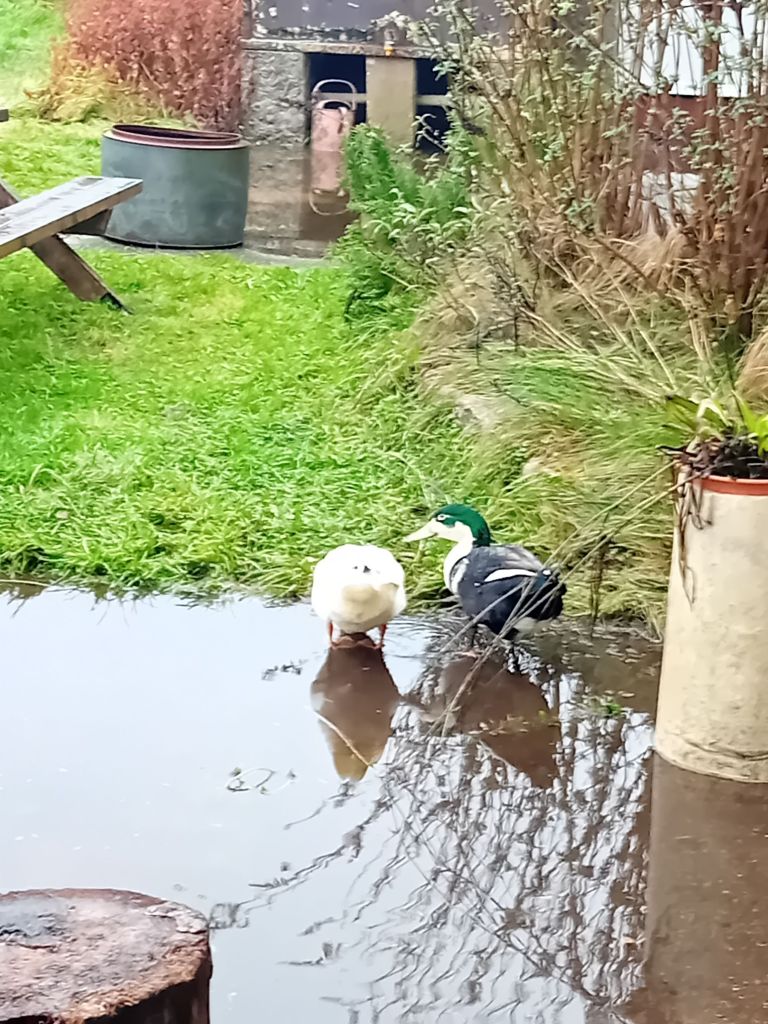
    Back home, I slew off my clothes and get comfy dry, confident that the trials of this wettest of days hold no other watery surprises. Opening the shutters that I’d forgotten about earlier in my haste to get going I do a double take. Instead of the patio that leads onto the lawn the ducks are enjoying a their new pond.

  • A bit of Erraid history

    Erraid is made of some of the oldest rock on earth. For 420 million years it has hosted multiple ice ages, temperate forests and intermediate eons. Look around at the near islands and they all show their age; Staffa, Little Colonsay and the Treshnish isles all demonstrate the flattening out of time, tides and temperatures. ‘It won’t be long,’ you think, ‘until they are worn to a flat disk and then, plop, in they’ll go.’

    Pioneer fauna wants to get a grip, but any surface of more than a 30 degree incline is bare. The plants simply can’t hold on; the surface too smooth and lacking the semi-permeable pocks and crevices of limestone or chalk. Where the rock relents, in the bowl of the mid-isle, the peat is thick; bog water the colour of stewed tea. After hard rain, the sea turns from clear to brown until the tide takes it out again.

    In stark contrast Balfour bay is a fine, white sand beach and, a few miles around the east coast of Mull, there is the Black sand beach of Carsaig.

    Human habitation can be traced back as far as 2500bc and the Beaker people, travelling north from the Rhineland. Later, Celts from Ireland, Picts, Vikings and Saxons, until the Scottish clans of Campbell, MacLean and MacDonald settled in to a steady rhythm of internecine sacking and massacring; and agriculture when it was quiet.

    After countless shipwrecks off the Ross of Mull (24 in the year spanning 1865-66, at the cost of 21 lives), the Northern Lighthouse board proposed that a lighthouse be built on a rock 17 miles out to sea, due south of Erraid, called Dubh Artach. They engaged the company of David and Thomas Stevenson who had already built up an impressive portfolio of lighthouses in hard-to-reach places. Erraid was decided as the construction base and was therefore changed from an uninhabited outcrop to a major construction site. Thomas Stevenson brought his son along for a few extended visits. Later, Robert Louis was to use the landscape of Erraid in his books ‘The Merry Men’ and ‘Kidnapped’, Balfour Bay being named after David Balfour, the hero of the latter.

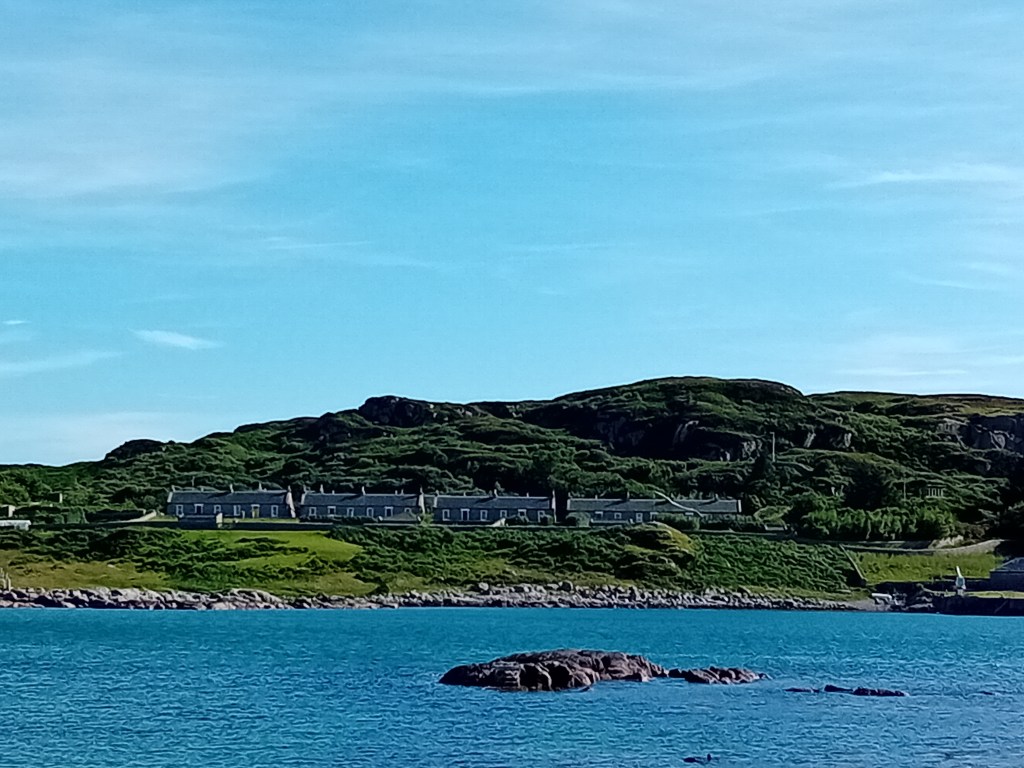
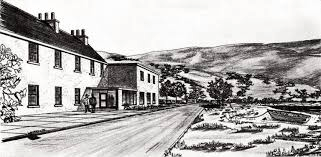
    A broad pier was constructed, along with a boat house and a street of cottages for the construction workers and their families. These would later turn into the lighthouse keepers cottages and, much later, the cottages lived in by us and visited by people from all over. 

    Stone was quarried from 50 meters south of the pier, cut and dressed to precise measurements and then dovetailed so all pieces interlocked. No mortar was used between any stone on the lighthouse. During construction the conditions were a constant problem, so that it was only possible to land on Dubh Artach occasionally. Prior to starting the build a cast iron domed structure was build on stilts and riveted to the rock on Dubh Artach. This was barracks for the workers. During one particularly bad storm 14 men were trapped for six days as torrents battered the outcrop and their metal shell, the sea breaching it on one occasion and washing away vital supplies of food. One can only imagine the desperate conditions during that prevailed.

    Victorian engineering such as this is barely fathomable. They dragged 2 ton granite blocks up a completely smooth rock far out to sea using hand winches, as the spray washed over, with nowhere to retreat to but an iron box! The lighthouse took 4 years to complete as, during that time, landing was only possible a total of 91 days. 3115 tones of rock were transferred and placed on those days. Just as the world was enthralled when Thor Hayerdahl and his crew set off over the pacific ocean in a raft to prove a point about early seafaring, so too I am disarmed by the sheer audacity of the idea, let alone the execution of it. Self-regard ignored in pursuit of a nobler aim.)

     It seems, remarkably, no one lost their lives during the construction. There were injuries reported, mostly body parts being hit or crushed by heavy stone. They all came back after a time to the cottages of the street, with their heavy doors and large, open fires of coal, to dry off, rest and sleep, in the knowledge that soon, when the sea granted permission, they would be out, at it again.

    The houses are semi detached, single story cottages, built of the same slivery grey/black as the lighthouse. There are heavy, hard wood doors with thick bolts to keep them shut. The windows are generous to the north and shrink towards the south, where the new kitchens and bathrooms are. The wide fireplaces that were once open still have huge clothes airers, hoisted on ropes, above them. Cottage number one used to be a school for the lighthouse builders and keepers children, and also for other local children that made their way across the narrows each day from the mainland. After lessons, the children would help in the gardens or any other domestic tasks. When they were done with that a fair few would be seen running around the perimeter walls that act as much-needed wind breaks for the crops.

  • Orientation

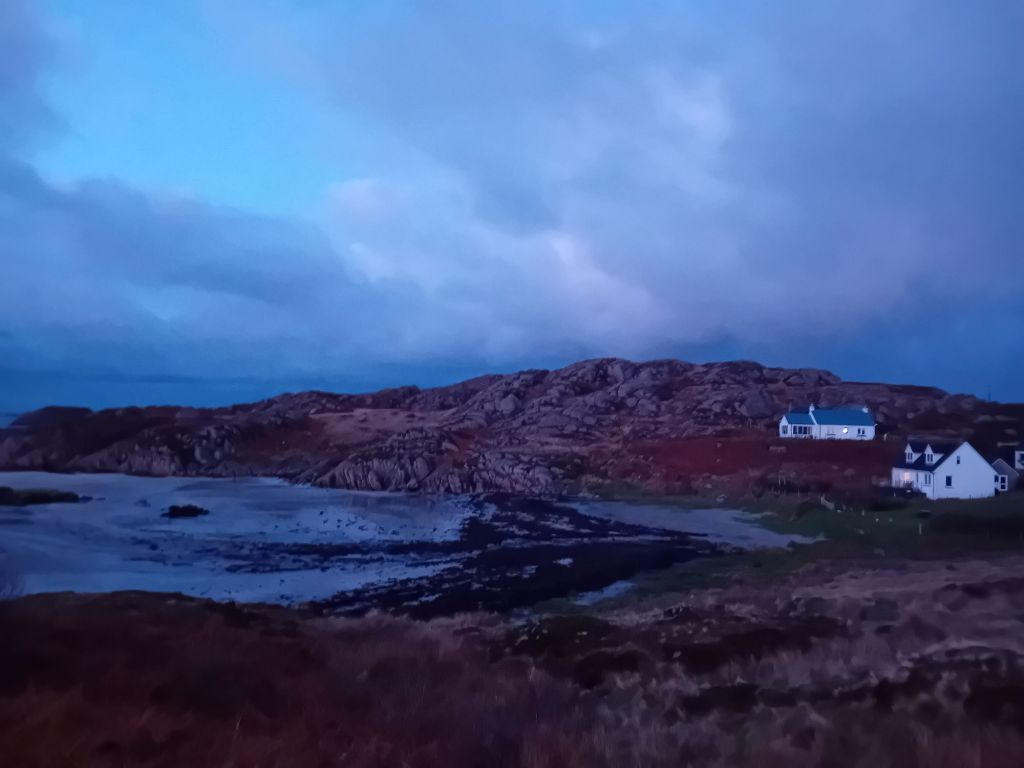
    The lighthouse keepers cottages from FIdden

    Take junction 13 north up the M5. Let it merge into the M6 and carry on north, past the tantalising
    Tebay services and other, more geographical marvels of England’s north. Travel through Glasgow—
    perhaps having stopped overnight in Carlisle—and continue to the beginning of the Highlands, bending
    left around Loch Lomond first. Squiggle through gently inclined valleys until Oban appears, quite
    suddenly. Rest a while as the CalMac ferry reduces its schedule to a paper exercise, then enjoy the often
    choppy sail to Craignure, Mull.
    Exit left and prepare for over an hour of single-track road with passing places, where blithe, wide
    camper vans dally and locals rally. No, they haven’t forgotten to turn off their indicators—they want to
    get by! Skirting Loch Scridain with its views of the sheer western peninsula, try not to crash. Turn left at
    Fionnphort, left again at Fidden, wiggle, wiggle, wiggle. Park at Knockvologan, put wellies on, carry
    what you can, and hike down—over the beach if it’s not submerged (in which case, take off your wellies
    and wade or go back to Fionnphort for the night if you start getting pulled out to sea). If you’ve made it
    over, you are now on Erraid. Follow the coast northwest, past Judy’s cottage, up the tractor track,
    through the gate below the old schoolhouse, and find someone to say hi to.
    After welcomes and refreshments, there is often talk about the journey—whether the newcomer found
    the island with ease or difficulty. Last week, however, a different conversation began in hushed tones,
    sparked by a daughter who had come with her mother:
    ‘We are in Findhorn, right?’\ ‘This is Erraid. Findhorn is three hours north of here.’\ ‘I didn’t
    think the Findhorn Foundation was on an island. What shall we do?’\ ‘You’re welcome to
    stay.’
    They ended up having a lovely week.

    It’s not as silly as it seems. Until very recently, the island of Erraid community was run by the Findhorn
    Foundation. Findhorn is famous in New Age circles for transforming a barren piece of land in the 1950s
    into a beautiful garden and retreat centre—with all the fabled giant cabbages you could eat. COVID had
    a major impact on operations, and the foundation has now shrunk to a fraction of its former size. As a
    result, it has rationalised its activities, passing the running of Erraid back to the island’s owners, the Van
    De Sluis family.
    An intentional community is one where a group comes together for a common aim. Here, it is to be as
    self-sustaining as possible and to be guardians of the historically important lighthouse keepers
    cottages. It’s difficult to be completely self-sustaining and, as one member recently pointed out, not
    even desirable—that would negate cooperation with the neighbours, a vital part of life in remote
    communities like the Ross of Mull. We also host paying guests who come to experience community life
    —usually for a week—or to retreat and take time for themselves: walking, reading, finishing a writing
    project, that sort of thing.
    There are six of us who have committed to a long-term stay here, usually between one and three years.
    Apart from Magnus, none of us have been here more than two months. Beyond the geographical
    remoteness from towns, shops, and services, building a workable, sociable, and fun group is the
    biggest task—the challenge we accept and work on every day. It quickly becomes clear that it requires
    more than simply making friends with five other people. We need to build systems that allow us to
    navigate any eventuality—from minor disagreements to deploying resources during a critical medical
    incident. We’ve all had some experience of communal living and decision-making. The selection process
    was rigorous, with probing interview questions, but we all arrive with our own habits, tics, tendencies,
    and foibles. Some of us tend towards overworking, some to introspection, others to extroversion. We need different amounts of personal space and time alone. Some get ill more often; some have
    diagnoses that require consideration. All of this needs ongoing attention and care.
    A lightness of touch is essential. In all the personal communication, the maintenance, cooking, ordering
    of supplies, caring for animals, and tending gardens, remembering that, as Alan Watts put it, “we are at
    play” is key to thriving here. The weather plays—battering rain into full sun in the time it takes to boil an
    egg. The sea plays—changing from clear blue to peat-brown after rainfall, varying its tides and currents
    so you never approach the far jetty quite the same way. The land plays—step off the street and the
    ground becomes ever-changing, from ageless granite to welly-eating bog to fine white beach sand.
    Yielding to all this is essential: a willingness to say “yes” to the games offered here. To learn the rules. To
    accept that sometimes you will be “out” and must contend with sea spray, cancelled ferries, a boot full
    of brackish sludge, or a waterproof jacket that worked perfectly well in the Cotswolds—but not here.
    To remember to be at play is to surrender. Not everything will get done today—not in the way you
    thought, anyway. The unexpected lurks around corners to test whether you’re still playing the game: an
    overflow pipe suddenly spewing water, an outboard motor that won’t start, the mobile cinema turning
    up in Bunessan. Can you welcome the novel and disruptive as the jokers in the pack.