Tag: nature

  • A night out

    Every year a group of teachers from the mainland come to Mull and give workshops to the kids. Subjects include traditional music and dance. We had heard that some of them would be at the Bunessan Inn this evening, so we thought we’d pop along. It has been noted that we are long overdue a community outing, and that this would be a perfect opportunity to eat some deep-fried food and build connections with the wider community.

    Of course, as regular readers will know by now, popping down to the pub involves checking the WillyWeather app to see how high the tide is, so we can actually get off the island and back on again at roughly the times we want. The last two outings have ended with boots, socks and trousers off, wading through thigh-high, punishingly cold sea to get back home. Tonight looks more benign, save for the gale-force easterly wind.

    Two of my Christmas presents make life easier when making the trip from the street, across the narrows and up to the minibus at Knockvologan. First, the head torch (thanks, daughters!) turns pitch black into what looks like a slightly overcast day. Others cower back into the darkness when I turn to talk to them, such is the power I now possess. Not great for conversation, but excellent for avoiding the boot-devouring bogs that punctuate our route. Second, my new waterproof coat (thanks, Mum!). This bright, 1980s, orange-squash-coloured item (a colour described by a close neighbour as horrific) is totally waterproof. Not a light-shower-in-the-Cotswolds waterproof, but a barrage-of-seawater-on-a-commercial-fishing-vessel waterproof: nothing gets through. It is also completely windproof, which is more pertinent tonight.

    We reach the minibus and there is real concern that the hinges of the doors might rupture, so we hold them steady as we climb in. There is a collective sigh now that we are out of the wind, and we change from our wellies into our civilian trainers and shoes. Bunessan is about twenty minutes away and, unusually, we don’t have a list of things to do on the way, so we just drive straight there. As always, I am the designated driver, as no one else can drive or get insurance for the bus. Slightly frustrating at times, but cheaper.

    The Bunessan Inn is, apparently, 300 years old and was frequented by Dr Johnson and James Boswell when they were trying to track down some decent whisky. The website says they failed in their endeavour, as all the good stuff had been drunk two days earlier at the funeral of a popular local chap. That’s the story the Bunessan folk tell, and they are sticking to it.

    It has a more modern feel on entering. There is an open fire in the smaller bar, but when you walk through the portal you are transported into the 21st century — or at least the late 20th. The dining area might feel familiar to those who visit relatives in retirement homes. However, to the rear, the modest bar area is dominated by two oversized Tennents taps, and beyond that is the pool table and darts board that provide some of the only live sport south of the Mull Rugby Club in Craignure. After being served a pint — and, not to labour the point, but for general H&S information, my only pint — we are shown to our table. We talk about holding hands and blessing the meal but decide that, despite it being common practice on Erraid, and having watched The Wicker Man last week, we will simply raise a glass to being around a different table together.

    The battered haddock is the size of my forearm with my hand extended. The chips are chunky, though not especially crispy. It’s clear that the normal clientele may chat and pick around certain garnishes and relishes, but we fall to with little talk and great focus. When we have finished, the middle-aged waitress says something I haven’t heard since my teenage years around the table at Nana’s house: “It’s so lovely to see nice clean plates.” Indeed, everyone has eaten every last morsel. The token side salads are gone and even the sauce bowls look as though they have been licked clean. The sticky toffee pudding for afters (a “nice clean plate” being a prerequisite for pudding at Nana’s) is dispatched in similar fashion.

    The music starts with an accordion and grows into a modest gig with a keyboard, a couple of fiddles and a snare drum. These look and sound like locals, not the polished professionals from the mainland. Once someone remarks that all the tunes sound like the theme to Captain Pugwash, I can’t hear anything else. Archie tells me there are bagpipes on the floor next to one of the players, which I can’t see due to the large pillar obscuring my view. Ten minutes later, halfway through an anecdote about an Australian cane toad, there is a sharp pain in my left ear, like the start of a migraine. My suspicions are confirmed: the bagpipe is an outdoor instrument.

    It’s great to realise that we are slowly building up a group of friends who live and work on the Ross of Mull. Some we know through work they have done on Erraid, others through community events. I’ve never been one for networking, but I understand that here it is how things get done and how people connect socially.

    There is a graph somewhere that depicts how much time it takes a certain number of people to leave a pub while having to say goodbye to a certain number of other people, possibly taking into account alcohol consumed. Being the driver, I have leverage here and, after five minutes of milling around waiting, I stride purposefully towards the exit. The message is clear. I swing out of the car park and someone mentions that Archie is still inside. I do the old pulling-off trick when he approaches, which amuses the slightly intoxicated passengers.

    Back at Knockvologan, the wind has dropped and it is a pleasant walk back onto the island, with minimal wading. We are all back in our snug little cottages by eleven, which is a late one for us.
  • Rubbish

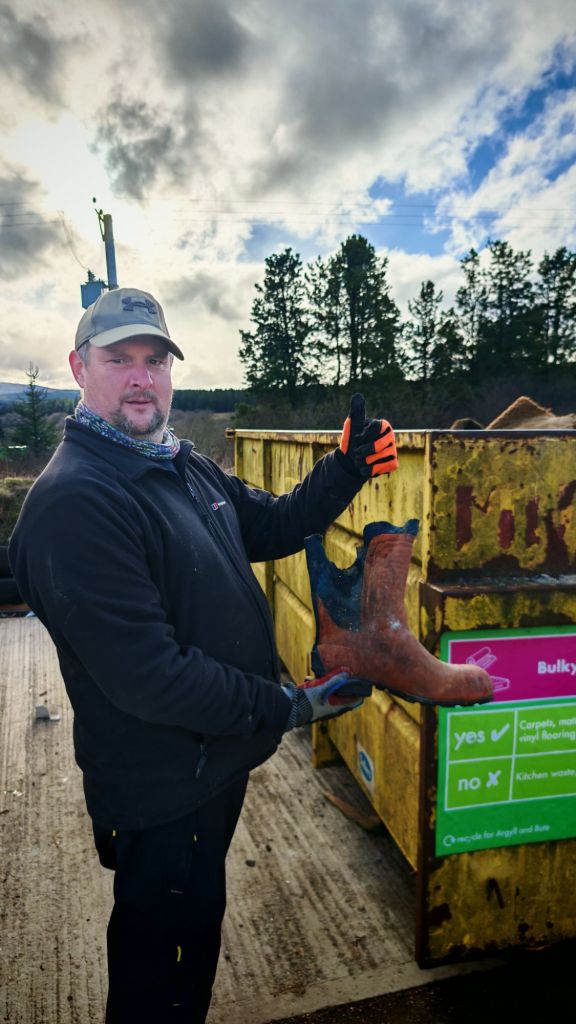
    Getting rubbish off the island, especially when doing renovations, is a time‑consuming business. There are decades’ worth of things that ‘could come in handy’ on Erraid. The purge we are undertaking is for those things that obviously haven’t come in handy for at least 20 years: old fishing tackle, knackered creels, rope, ripped life jackets, rugs, underlay and bathroom tiles. To get rid of it all, we have to wait for a low spring tide, load everything onto a tractor, and drive it across to the other side of the estuary, where the minibus waits to be stuffed to the gills. Last time we needed a lot of stuff taken to the tip, we paid someone to do it. Today, we are experimenting with the economy of doing it ourselves.

    It’s 8.30am. We boat over to the bus. The sea is choppy and we risk enduring the whole trip with wet trousers. We shuffle to the back of the boat, which gives us just enough lift at the front to ride the waves.

    It’s a one hour and fifty minute trip up to the Tobermory recycling centre. Armed with Archie, Marianne and a Bluetooth speaker, I set off, stopping at Miek and Rutger’s place so they can load a sink and toilet into the back and save themselves a trip. Inside, the minibus smells of foetid undergrowth where aerobic respiration has clearly faltered, so despite the biting cold, the windows are open. I remember that, despite my best efforts, the two outer rear tyres are looking flattish, so we stop at Robin’s garage to see if he can put some air in them and to fill up with fuel. As an old local once said to me, you should treat a half‑full tank as empty around here.

    Robin has a compressor, but only a front‑on nozzle attachment. I need a 90‑degree nozzle, so Archie is tasked with putting five minutes’ work in with the foot pump. Neither of us is convinced it’s making any difference. Robin then uses a customer’s car to power our very short‑cabled mini‑compressor, but stops after a few minutes as he doesn’t want to blow a fuse on a car that’s there for something entirely unrelated. We nod and see his point. I’m sanguine about completing our task anyway, as there are dual tyres on the back. I still stop at the garage in Craignure to see if they can take a look. They tell me to come back in the afternoon, once we’re done up north.

    The Mull Chocolate Shop is open—a rare treat. I’ve been wanting one of their millionaire shortbreads for four months and six days, but they are always shut. Too often with such confections, the caramel is right and the chocolate has a satisfying bite, but it all sits on a terrible bed of floury, dry shortbread that collapses onto the floor after the first nibble. Not this stuff. It has a real snap to it, is slightly bronzed, and you can feel the butter that holds it all together gently melting as it goes down.

    We pop into the Craignure charity shop, which always has cheerful older staff waiting with a smile. They are stocked mostly by people dropping off things they no longer need at the end of their holiday, just before getting on the Oban ferry, which you can see pulling in through the glass front door. The good thing about this shop is that they don’t look things up online to see if they’re ‘designer’. Nor do they check labels to see what material an item is made from. This means that a jumper—any jumper—is five quid. A T‑shirt is three, and books are one. This reintroduces the possibility of finding a genuine bargain, a pleasure sadly gone from the charity shops of the Cotswolds, where everything is picked over before display and priced so that, if you do find something decent, it is deflatingly expensive.

    The latest hits

    Our next stop is the commercial timber pier at Fishnish. I’ve been tipped off that a client has failed to collect a stack of logs and that they might be available. The chap I spoke to said they’ve been sitting there a while, so I want to check whether I’m about to buy 100 tonnes of rotten wood or beautifully seasoned fuel. There’s nobody around to ask which particular stack it is, so I wander about under the large cranes and make an educated guess based on colour. Timber, like most things, has doubled in price over the last few years, but it’s still much cheaper than relying solely on mains electricity. We use a mixture of both.

    We finally make it to the tip. We have all sorts of stuff and want to put the right things in the right skips. I tap on the window of the office cabin and disturb what appears to be the only member of staff. With his cerebral palsy slur and strong accent, he’s very difficult to understand. ‘So it all goes in that one?’ I ask, with some surprise. ‘Aye,’ he replies, already on his way back to his station. We try to be more discerning anyway, separating wood and metal.

    A chap pulls up in an estate car and two energetic Labradors bolt out. The somewhat obvious, but nonetheless enjoyable, conversation ensues about whether he’s come to leave the dogs at the tip. ‘It won’t be long if they keep eating the lounge and shitting on the shag‑pile rugs!’

    Fortunately, the reward for doing the tip run is the Mull Cheese Farm, a quarter of a mile down the road. Unfortunately, like many things on the island, most of it is mothballed for the winter and only a small selection is available in the already modest shop. Still, it’s a beautiful place, and one we’ll return to when the tourist season is in full swing.

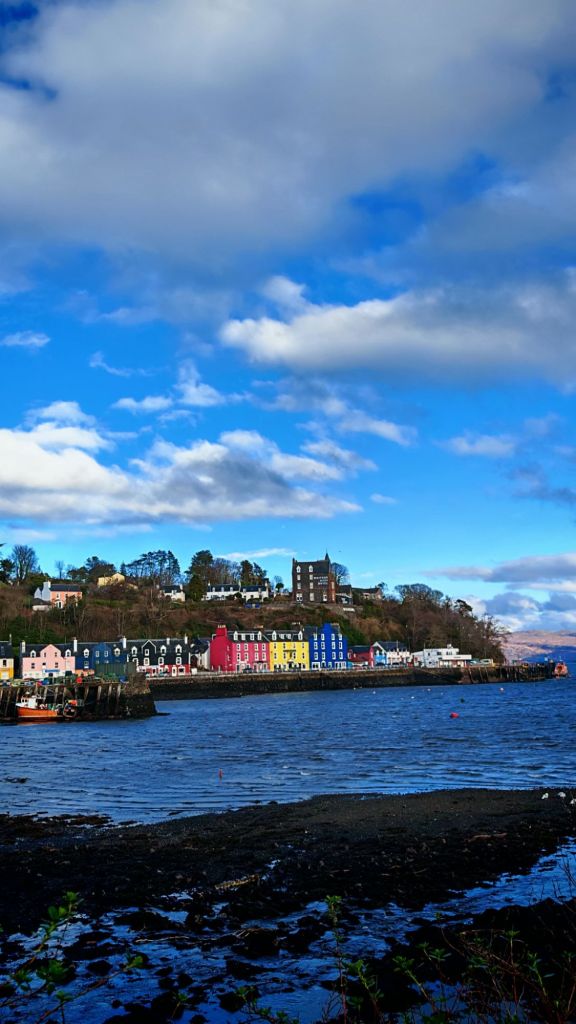
    Tobermory offers a similar experience. Most shops are shut. The obligatory beach sauna stands frigid at the back of the car park. The gaily coloured frontages of the high street don’t quite compensate for the fact that we can’t get a bag of chips for lunch. The pub is open, however, and the Slovenian barman pours pints and takes food orders while a scattering of patrons either sit pensively toying with beer mats or passively engage with a tennis tournament from a former Soviet republic playing on the large TV screen.

    We pop into Browns, which is a real treat. Remember those hardware stores that used to sell everything, before being taken over by such hideous things as Wilko and Home Bargains? Browns sells, in no particular order, hard liquor, ballcocks, tea strainers, referees’ whistles, dog jackets, laminators, binoculars, snooker cue chalk and ham. Sadly, it doesn’t stock fuel‑hose connectors for small outboard motors, which is what I went in for.

    The return journey is punctuated by a one‑and‑a‑half‑hour stop in Craignure to get the tyres fixed. It’s hard to fill this kind of time, as everything apart from the Spar is shut. We do several circuits of the aisles and buy unnecessary food items purely to pass the time.

    Back on the road, we do a quick calculation and realise we’ll get back to Knockvologan at exactly high tide. Having parked up and done up every available button on our coats against the wind, we guide ourselves by the dim light of our phone torches down to the narrows. We take off our boots, socks and trousers and wade into the dark sea. It reaches halfway up my underwear before I make land on the other side. No worries, though. Within twenty minutes we’re home, lighting fires and getting dry and warm again.

    • What’s it all about?

      Living in community is a funny thing. We’ve done it, in various ways, for thousands of years. Nearly all of pre-industrial life was spent in small towns or villages where everyone knew each other. Having a shared purpose was a given — getting the harvest in, building barns and houses, raising plants and kids. It was all an effort that went well beyond the scope of the nuclear family.

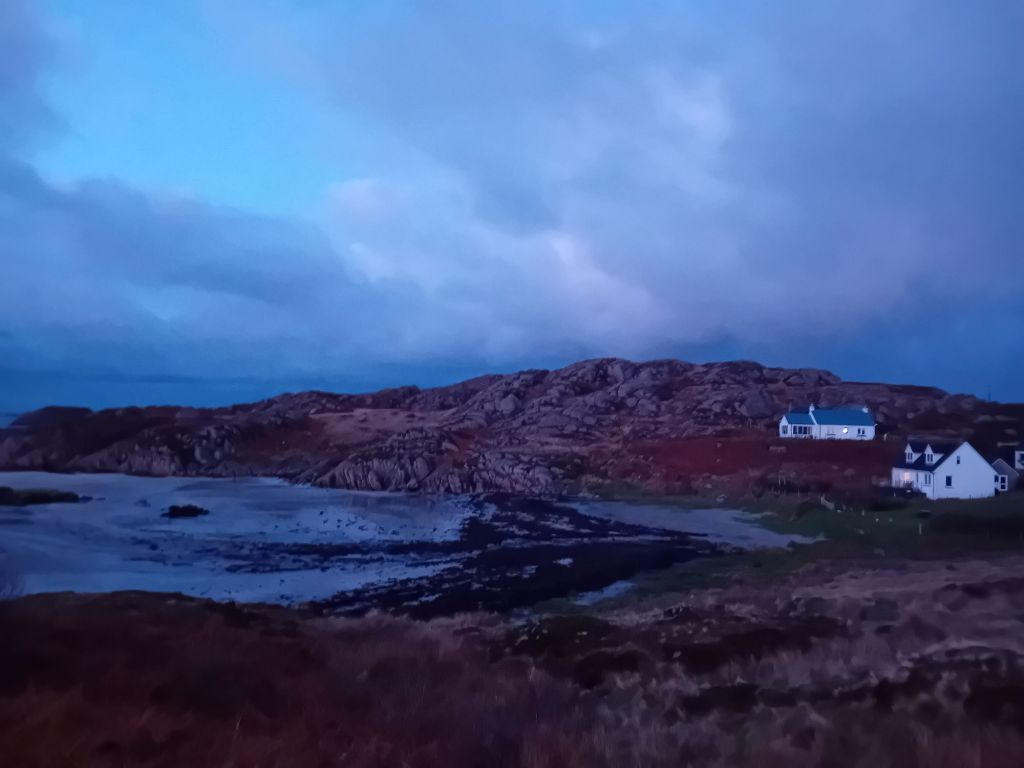
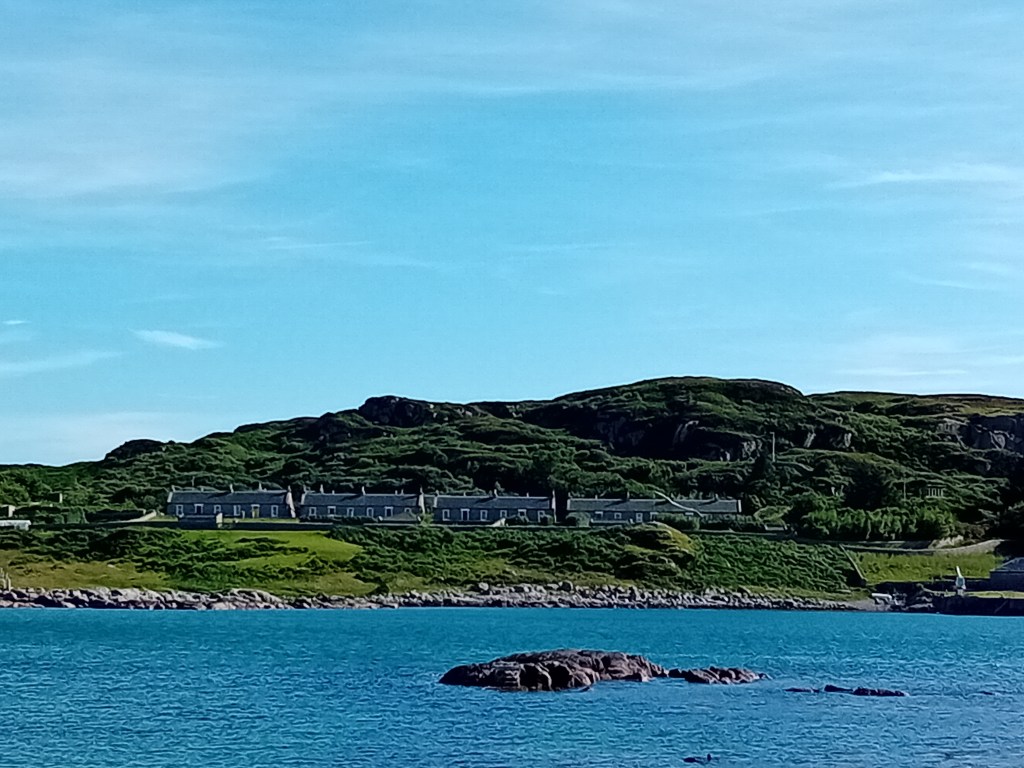
      On Erraid it has been no different. The houses we live in were built for lighthouse keepers and their families. A single street of seven houses, plus community rooms, makes it easy to see and meet everyone as they go about their daily chores: collecting peat, gathering seaweed for the garden, tending plants, children, and livestock.

      Before the street, there were crofters eking out a living from the sodden earth and rich sea. Long before that, people lived in wattle and daub huts — those who, for whatever reason, had chosen to make this gnarly and beautiful island their home. Some may have been pushed to the edges of their known world by ruthless landlords or invaders. However they arrived, the sharp bite of island life — and what it entails — would have been felt.

      It has always been a logistical challenge to live here. The enduring question is: how much food can we produce on the island? The limitations of access haven’t changed in modern times. The tides are still the same, and they dictate when we can drive the tractor over to the mainland to deposit rubbish and pick up supplies.

      A few months back, when the tractor stalled in the middle of the estuary on an incoming tide, if it had been a horse, a few slaps on the backside might have sufficed.

      As if to illustrate the point further, the tractor packed up again yesterday — and this time it’s nothing we can fix. The “just contact your nearest dealer” option doesn’t really fly around here. It’s far better to have built up a local network of people who can do the things we can’t.

      In practical terms, this means we’re now wheelbarrowing loads of logs up to the houses and kitchen. If this becomes a long-term issue, we’ll use all the wood we’ve cut on the island with no way of getting more from the other side of the estuary, where logs are usually delivered. We also can’t collect seaweed for the garden, or remove rubbish and recycling. The need for inter-sufficiency, rather than self-sufficiency, is paramount. We’re going to need help — one way or another.


      Coming back to the broader question of why we’ve all found ourselves here: what is our direction of travel, individually?

      Like those who came before us, are we moving away from something — or someone? Trying to put physical or psychological distance between ourselves and parts of our old lives? Or are we moving towards something, drawn by novelty and perceived possibility? Has the island offered us a new blueprint to play with in its wild surrounds?

      These questions matter because our fears, judgements, and projections inevitably arrive with us. When the only human habitation is a small row of cottages, there aren’t many places to hide them. We see this with guests who imagine their troubles will have stayed behind in the house they left. What many discover instead is that their troubles have not only travelled with them — they stopped for a double espresso on the way and arrived ready to party.

      The island shows you exactly where you are: with yourself, and therefore with others. It’s confrontational, and it demands accountability. There is a special time when this is magnified five-fold — when everyone is knackered.


      The five of us have been plate-spinning since August. A few plates have dropped from their poles and smashed on the rocks, but most we’ve managed to keep going. Then, a few weeks ago, guest season ended. For the first time, we could take the plates down and really look at their designs.

      All the team-building work we’d planned to do back in July — when we first met each other — but didn’t, came hurtling towards us and slapped us around the face like a giant mackerel. Simmering resentments surfaced. Questions emerged: who was doing how much work? Why do some people socialise in the evenings (good) and others don’t (bad)? Are people here long-term or short-term? Why does one person seem to ignore another in group discussions?

      No outright accusations — just questions. When a fuel tank is almost empty, it drags gritty petrol into the engine in an effort to keep going.


      We were all a bit on edge when Fabio arrived. His visit had been arranged for us, not by us, and we were sceptical about the kind of help he was offering. We thought we needed fairly direct conflict resolution; his focus seemed to be more on operational systems.

      But the sign of a good facilitator is economy — and Fabio had it by the truckload. After a brief introduction, he invited us to talk about why we were here and what we wanted to achieve. It was like magic. With a few tricks, a lot of Post-it notes, and some semantic sleight of hand, he had us eagerly discussing shared dreams and challenges. And just like that, the rancour and tetchiness of the previous weeks evaporated within twenty minutes.

      After three days, Fabio went on his way (despite our threats of kidnap). We did some great work on mission and vision statements, though I remain scarred by two decades of INSET days in schools. I’ve opened too many cupboards looking for a stapler, only to be knocked flat by dusty piles of Post-its and flip-chart paper covered in mission statements written in red pen, surrounded by hearts and stars that never saw daylight again.

      What we’ve taken on is big, and still largely undefined. We all need to go away and have a quiet conversation with ourselves and ask: are you up for it? And in answering that question, it’s worth remembering that we may have considerably more choice than mos who came before us.

    • Deluge

      ‘Water, water everywhere,
      And all the boards did shrink,
      Water, water everywhere,
      Nor any drop to drink.’

      The Rime of the Ancient Mariner, Coleridge

      There are new streams on either side of the road from Fionnphort to Knockvologan. They were not there yesterday and have sprung into life in mere hours. The tarred surface seems now more causeway than road. Ponds sit afresh on the fields by the sea. Even the sandy soil cannot drain away this much water. The grey geese are enjoying this new wonderland, sitting proudly afloat as if to confirm their decision to forgo their migration, full of risk and energy.

      Since the early morning there has been driving drizzle from the east that has saturated Mull and Erraid. The sky is a single sheet of grey that squeezes the tiny fleas of moisture, sending them jumping and skittering amongst each other until they finally settle on the ground — in the fleeces of sheep, on the flight feathers of angry storks, on the roofs of the scattered dwellings that ring the bay, and on the hoods and trousers of those who must be out. From all these places and more they gather strength and force, joining with countless others to charge down the hillsides, finding crevices from previous storms and forging new channels and thoroughfares — the quicker to make it to sea level. Pipes that run under the roads are nearly at capacity.

      It hasn’t felt like a downpour of any great magnitude, but the sheer thickness and persistence of the squally, misty rain has penetrated deep into the ground and worked its way up through the peaty marshes, unable to reach the sea quickly enough. The thick gravel on the surface leading up to Fidden Farm has been parted in several neat channels and now runs clear into the middle of the road. The hard standing where our wheelie bins sit is submerged, and the hut that serves as our post box is perilously close to being overrun.

      We’ve walked up to where the car is parked by Glen and Rachel’s place and are soaked through — or rather, I am. My standard-issue Cotswold outdoor attire is no match for this weather. The brook where the watercress grows is surging so much that much of it has been dislodged. As we walk up the field before the single-track road, four sheep are stood in front of a rocky outcrop looking dejected — like an unsigned goth band on a photoshoot for their first single. I change from my wellies into my hiking boots to drive and, while my trousers cling damply to my legs, I’m happy to be inside.

      I am taking the car for its MOT. There is a worrying clanking coming from underneath, and the salty spray from the ocean is playing havoc with the metal. I drive an hour to Craignure and leave it with a young mechanic who appears to be an elective mute. By way of nods and raised eyebrows, I trust that the message about letting me know how much it’s going to cost before doing anything has landed.

      In the sun, Craignure is not the kind of place that holds much attraction for those looking to linger and relax. In driving rain, there is instead an urgency to leave — to return to where I started an hour and a half ago.

      It is an unexpected pleasure to sit in a coach for the return journey. I can enjoy the remarkable scenery without fear of driving off the single-track road. Shortly after leaving the village we enter the valley that stretches for twenty miles. I am free now to gaze at the cascades that run off the high hills in silver ribbons — the seemingly vertical plunge of stormwater from the peaks of Ben More that eventually comes to rest in the three lochs, or in Loch Beg. Further on, heading through the valley towards the Ross, and looking over to the right — with Lunga and Staffa a way off — the sheer cliffs of the Berg are so steep that the water flows straight into thin air for a while before being blown back onto the rock face.

      All the while the road is filling up, and I’m glad that I’m on the coach, with its big wheels and high chassis. What is less appealing is the prospect of having to hike from Fionnphort to Knockvologan. However, after stopping off at the ferry café for a leisurely lunch of a toasted cheese and ham sandwich, a slab of chocolate tiffin and a latte, I feel I’m ready for anything.

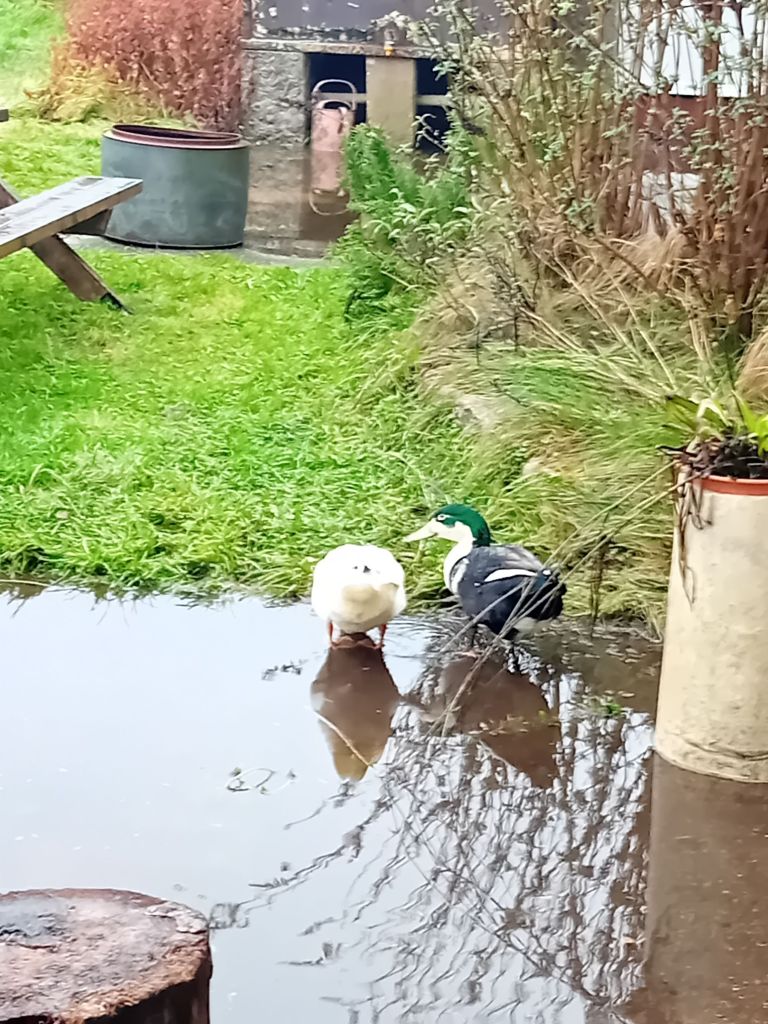
      Back home, I slew off my clothes and get comfy dry, confident that the trials of this wettest of days hold no other watery surprises. Opening the shutters that I’d forgotten about earlier in my haste to get going I do a double take. Instead of the patio that leads onto the lawn the ducks are enjoying a their new pond.

    • The Sea, The Sea

      We go to sea in a small boat powered by an outboard motor. She’s strictly functional—two boxed metal seats and a closed bow, where a brave soul can perch if they don’t mind getting soaked. She has anchor points with sturdy ropes, like the kind used on ratchet straps, for lifting her out of the water and onto her trailer.

      Oranja, our winter boat, is made of aluminium. She’s a little more skittish on the water than her summer cousin, Reliance, who’s built from reinforced fibreglass. It’s unusually calm for mid-October, so we’ve taken the chance to set the creels for the final time this season. We take a wide arc around the west side of Erraid, into the Iona Sound. The creels are sited where the water is deep but close to land, so care is needed—swiftness and accuracy with the buoy hook are essential. Once the rope is gathered, the hook goes back into the boat and the arduous task of pulling the creel from the seabed begins. It takes about 30 seconds, and the hardest part is hefting the creel over the edge and into the boat.

      This time, there’s a surprise waiting for us—a very angry moray eel thrashing about. These creatures can easily bite through a hedging glove and do not let go once they have a good hold. It’s always a bit nervy opening a creel when there are crabs inside, but this is several levels higher on the nervy chart. I tilt it back over the side as far as I dare, unhook the catch, and shake vigorously. Luckily, it slides back into the depths straight away, though the whites of its eyes stay with us for a while longer.

      After three more creels, we have a good number of velvet crabs—excellent for making bisque. All the lobsters are too small and go back, though we keep one large brown crab. Out of six creels, we can only find four. They don’t just disappear; someone must have removed them. There’s a local fisherman with a reputation for this sort of thing. He’s taken umbrage at the hobbyist, amateur fishing we’re doing, as it seems to interfere with his professional enterprise. When one Erradian accidentally began pulling up one of his creels, the man happened to be nearby and threatened to kill the poor soul who’d made the mistake.

      We venture out into more open water. Two other small vessels are checking creels, one belonging to our tetchy neighbour. We give him a wide berth and turn to head back when we notice an unusual disturbance ahead. Binoculars in hand, I train them on the area and spot a school of about fifteen dolphins. We head straight for them, and after a moment—probably hearing the motor—they head straight for us. Common dolphins, with short beaks and dark blue backs fading to pale white tummies, they swim alongside us, crisscrossing in front of our bow. When they breach, the older ones have nicks in their dorsal fins, while the youngsters are unblemished. They swim so close we can hear them talking to each other in clicks and squeaks. We play together for perhaps fifteen minutes before they head off to investigate a larger boat that likely has by-catch overboard.

      Once we’re sure the dolphins have truly left the area, we settle in for a bit of mackerel fishing in hopes of a tasty dinner. It’s the definition of hit-and-miss. Sometimes there’s nothing at all, but this time, within seconds of the line going in, there’s a tug and three wriggling captives are landed. Their shimmering blue-green markings catch the late afternoon sun. We try a couple of different spots and stop when we have ten—enough to share with the rest of the community, to eat fresh or perhaps to smoke.

      I’m still new to boating on the high seas and get a tremendous thrill out of it. I’ve always had good sea legs, and I’m beginning to learn the coastlines, the dangerous rocks, and the navigation points that guide you safely around the island. I like being back on land again too! I realise I use a lot of adrenaline at sea—it’s still a foreign, almost alien environment to me.

      After Oranja is hoisted high in the air by the marine crane on the pier and settled back into her trailer, we hang up our lifejackets in the boathouse and wander, ever so slightly wobbly, back up to the street. A conversation awaits about what to do with the fresh catch.


      The next day finds me, towel in hand, greeting the chickens on the way to my morning swim. Oranja rests quietly, and the crane—itself like a giant seabird—is at peace. I no longer hesitate; it takes an act of will to get in, but it always sets me up for the day. Today, though, I dally. As I begin to descend the metal steps, I notice a face looking back at me from just beyond where the stairs end: a large-nostrilled fellow with big black eyes and a surprised expression. Whiskers fan out to either side, framing a mouth that seems to ask, Are you sure this is a good idea? Mighty chilly, you know!

      Grey seals are having pups now, and some come right into the bay, rolling and chasing each other. I’m sure it wouldn’t have minded me—might even have enjoyed my company—but it was I who shied away, not quite at ease with the idea of swimming alongside such a large beast. I waited a few minutes until it had rejoined its friends on the rocks near Iona before taking my frigid plunge.


      Perhaps tomorrow, the seal and I will share the water—though I doubt it will be impressed by my stroke.

    • Ducks

      Ducks. Ducks. I’m happy just saying the word several times to myself when no one’s around. It’s a matter-of-fact–sounding word that reflects well on the animals themselves. I wonder if canard has the same feeling for French people, or Ente for Germans. Perhaps the most satisfyingly onomatopoeic is pata (feminine) and pato (masculine), although the association with pâté is a bit too close.

      The ducks arrived in a cardboard box from the mainland. Someone was just giving them away. Some members of the community were displeased that they were made to sit through a yoga session before the return journey to the island. We hastily rigged up a heat lamp and a small enclosure, placing them gently on the ground where they immediately huddled together under the lamp—their fluffy yellow bodies turning a pinkish red. The urge to go out and start constructing an aquatic wonderland was strong, but all they really need is an upturned bin lid with a bit of water in it so that they can clean and keep parasite-free. The byre, newly free of chickens, felt very big and dark for four small ducklings. It was agreed that they must have access to the outside as soon as practically possible.

      It was at this point that summer break happened and I headed back south for a month. The thing with most ducklings is that they are yellow, and you can’t really tell how they’ll look once they get their adult feathers. So, on my return I was eager to find out what we’d got.

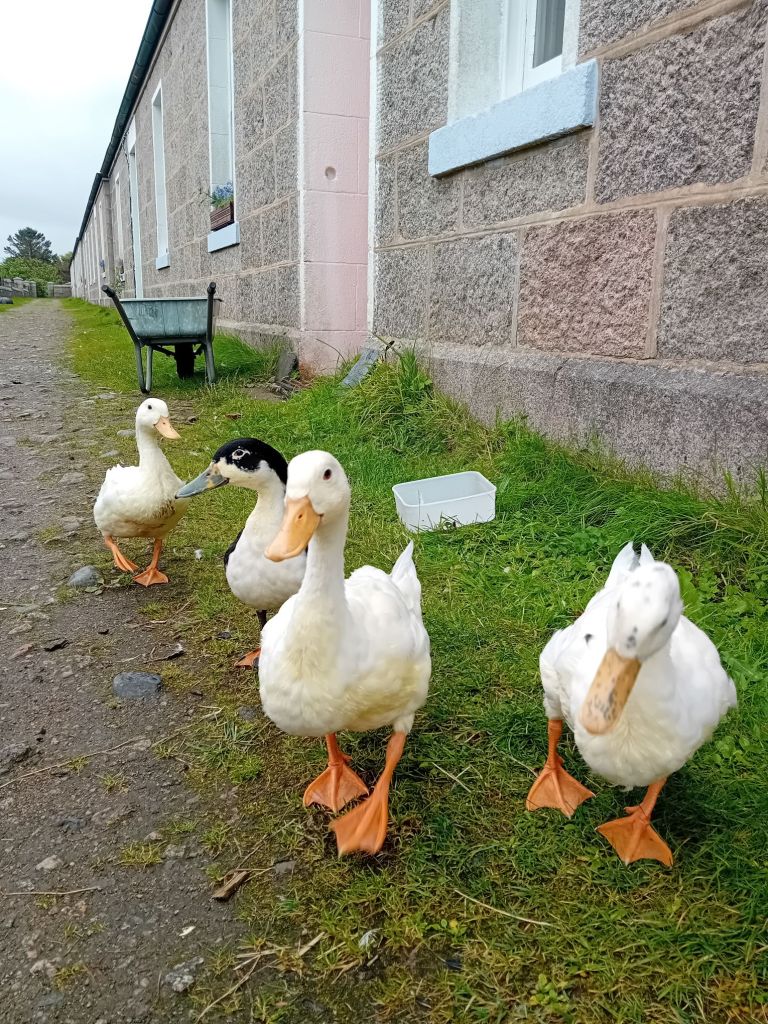
      They had been moved to a paddock all of their own, with a house that used to be the privy for the lighthouse keepers and their families in Victorian times. The grass had been left to grow tall, as John the crofter takes a few bales of hay from it each year. Rubi, Ophelia, and I went on a sort of micro-safari, trying to figure out where in the paddock they might be. Their ducky mutterings gave them away in the end, and we saw them in a flattened clearing just big enough for them. Two had become almost entirely white, one was more speckled, and the other was mainly black; they were only mildly disturbed by our presence. Having made their acquaintance again, we left them in peace. At that point in their development they were just generating low-level, conversational quacks. They are now beginning to practice their adult vocalisations, which can take you by surprise if you’re close by.

      They have taken to parading up and down the street. They enjoy getting into the corners where buildings meet the ground and the grass has grown longer for want of strimming. They shake their beaks furiously, burrowing them into the place where the grass meets soil—where all the bugs and slugs might be hiding. For the past couple of weeks there have been short, fierce downpours throughout the days, and the ducks make the most of the temporary puddles; they are straight in, drinking and cleaning their broad, smooth beaks that are dirty from digging. The sound of four ducks walking towards you through fresh, muddy puddles is a fantastic thing. Beatrix Potter’s description in Jemima Puddle-Duck, “pit-pat-paddle-pat, pit-pat-waddle-pat,” cannot be bettered.

    • A bit of Erraid history

      Erraid is made of some of the oldest rock on earth. For 420 million years it has hosted multiple ice ages, temperate forests and intermediate eons. Look around at the near islands and they all show their age; Staffa, Little Colonsay and the Treshnish isles all demonstrate the flattening out of time, tides and temperatures. ‘It won’t be long,’ you think, ‘until they are worn to a flat disk and then, plop, in they’ll go.’

      Pioneer fauna wants to get a grip, but any surface of more than a 30 degree incline is bare. The plants simply can’t hold on; the surface too smooth and lacking the semi-permeable pocks and crevices of limestone or chalk. Where the rock relents, in the bowl of the mid-isle, the peat is thick; bog water the colour of stewed tea. After hard rain, the sea turns from clear to brown until the tide takes it out again.

      In stark contrast Balfour bay is a fine, white sand beach and, a few miles around the east coast of Mull, there is the Black sand beach of Carsaig.

      Human habitation can be traced back as far as 2500bc and the Beaker people, travelling north from the Rhineland. Later, Celts from Ireland, Picts, Vikings and Saxons, until the Scottish clans of Campbell, MacLean and MacDonald settled in to a steady rhythm of internecine sacking and massacring; and agriculture when it was quiet.

      After countless shipwrecks off the Ross of Mull (24 in the year spanning 1865-66, at the cost of 21 lives), the Northern Lighthouse board proposed that a lighthouse be built on a rock 17 miles out to sea, due south of Erraid, called Dubh Artach. They engaged the company of David and Thomas Stevenson who had already built up an impressive portfolio of lighthouses in hard-to-reach places. Erraid was decided as the construction base and was therefore changed from an uninhabited outcrop to a major construction site. Thomas Stevenson brought his son along for a few extended visits. Later, Robert Louis was to use the landscape of Erraid in his books ‘The Merry Men’ and ‘Kidnapped’, Balfour Bay being named after David Balfour, the hero of the latter.

      A broad pier was constructed, along with a boat house and a street of cottages for the construction workers and their families. These would later turn into the lighthouse keepers cottages and, much later, the cottages lived in by us and visited by people from all over. 

      Stone was quarried from 50 meters south of the pier, cut and dressed to precise measurements and then dovetailed so all pieces interlocked. No mortar was used between any stone on the lighthouse. During construction the conditions were a constant problem, so that it was only possible to land on Dubh Artach occasionally. Prior to starting the build a cast iron domed structure was build on stilts and riveted to the rock on Dubh Artach. This was barracks for the workers. During one particularly bad storm 14 men were trapped for six days as torrents battered the outcrop and their metal shell, the sea breaching it on one occasion and washing away vital supplies of food. One can only imagine the desperate conditions during that prevailed.

      Victorian engineering such as this is barely fathomable. They dragged 2 ton granite blocks up a completely smooth rock far out to sea using hand winches, as the spray washed over, with nowhere to retreat to but an iron box! The lighthouse took 4 years to complete as, during that time, landing was only possible a total of 91 days. 3115 tones of rock were transferred and placed on those days. Just as the world was enthralled when Thor Hayerdahl and his crew set off over the pacific ocean in a raft to prove a point about early seafaring, so too I am disarmed by the sheer audacity of the idea, let alone the execution of it. Self-regard ignored in pursuit of a nobler aim.)

       It seems, remarkably, no one lost their lives during the construction. There were injuries reported, mostly body parts being hit or crushed by heavy stone. They all came back after a time to the cottages of the street, with their heavy doors and large, open fires of coal, to dry off, rest and sleep, in the knowledge that soon, when the sea granted permission, they would be out, at it again.

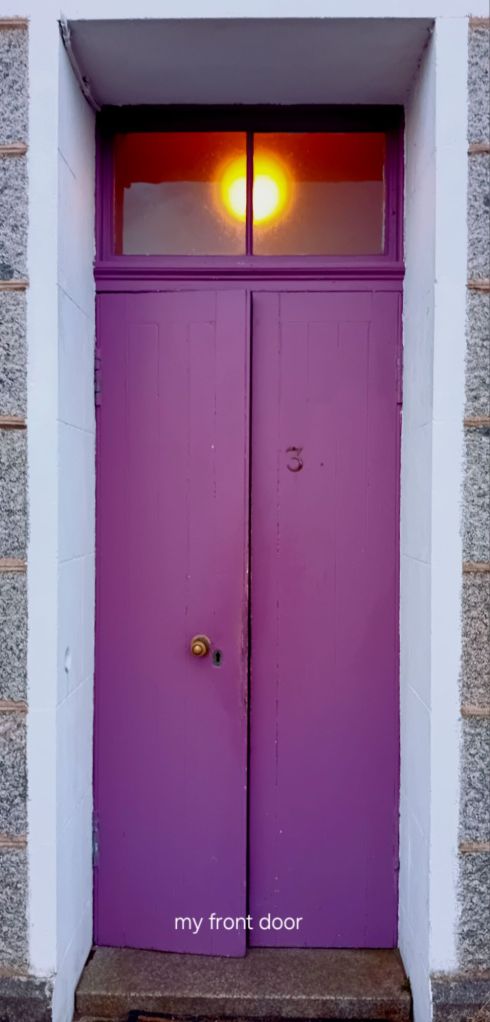
      The houses are semi detached, single story cottages, built of the same slivery grey/black as the lighthouse. There are heavy, hard wood doors with thick bolts to keep them shut. The windows are generous to the north and shrink towards the south, where the new kitchens and bathrooms are. The wide fireplaces that were once open still have huge clothes airers, hoisted on ropes, above them. Cottage number one used to be a school for the lighthouse builders and keepers children, and also for other local children that made their way across the narrows each day from the mainland. After lessons, the children would help in the gardens or any other domestic tasks. When they were done with that a fair few would be seen running around the perimeter walls that act as much-needed wind breaks for the crops.

    • Orientation

      The lighthouse keepers cottages from FIdden

      Take junction 13 north up the M5. Let it merge into the M6 and carry on north, past the tantalising
      Tebay services and other, more geographical marvels of England’s north. Travel through Glasgow—
      perhaps having stopped overnight in Carlisle—and continue to the beginning of the Highlands, bending
      left around Loch Lomond first. Squiggle through gently inclined valleys until Oban appears, quite
      suddenly. Rest a while as the CalMac ferry reduces its schedule to a paper exercise, then enjoy the often
      choppy sail to Craignure, Mull.
      Exit left and prepare for over an hour of single-track road with passing places, where blithe, wide
      camper vans dally and locals rally. No, they haven’t forgotten to turn off their indicators—they want to
      get by! Skirting Loch Scridain with its views of the sheer western peninsula, try not to crash. Turn left at
      Fionnphort, left again at Fidden, wiggle, wiggle, wiggle. Park at Knockvologan, put wellies on, carry
      what you can, and hike down—over the beach if it’s not submerged (in which case, take off your wellies
      and wade or go back to Fionnphort for the night if you start getting pulled out to sea). If you’ve made it
      over, you are now on Erraid. Follow the coast northwest, past Judy’s cottage, up the tractor track,
      through the gate below the old schoolhouse, and find someone to say hi to.
      After welcomes and refreshments, there is often talk about the journey—whether the newcomer found
      the island with ease or difficulty. Last week, however, a different conversation began in hushed tones,
      sparked by a daughter who had come with her mother:
      ‘We are in Findhorn, right?’\ ‘This is Erraid. Findhorn is three hours north of here.’\ ‘I didn’t
      think the Findhorn Foundation was on an island. What shall we do?’\ ‘You’re welcome to
      stay.’
      They ended up having a lovely week.

      It’s not as silly as it seems. Until very recently, the island of Erraid community was run by the Findhorn
      Foundation. Findhorn is famous in New Age circles for transforming a barren piece of land in the 1950s
      into a beautiful garden and retreat centre—with all the fabled giant cabbages you could eat. COVID had
      a major impact on operations, and the foundation has now shrunk to a fraction of its former size. As a
      result, it has rationalised its activities, passing the running of Erraid back to the island’s owners, the Van
      De Sluis family.
      An intentional community is one where a group comes together for a common aim. Here, it is to be as
      self-sustaining as possible and to be guardians of the historically important lighthouse keepers
      cottages. It’s difficult to be completely self-sustaining and, as one member recently pointed out, not
      even desirable—that would negate cooperation with the neighbours, a vital part of life in remote
      communities like the Ross of Mull. We also host paying guests who come to experience community life
      —usually for a week—or to retreat and take time for themselves: walking, reading, finishing a writing
      project, that sort of thing.
      There are six of us who have committed to a long-term stay here, usually between one and three years.
      Apart from Magnus, none of us have been here more than two months. Beyond the geographical
      remoteness from towns, shops, and services, building a workable, sociable, and fun group is the
      biggest task—the challenge we accept and work on every day. It quickly becomes clear that it requires
      more than simply making friends with five other people. We need to build systems that allow us to
      navigate any eventuality—from minor disagreements to deploying resources during a critical medical
      incident. We’ve all had some experience of communal living and decision-making. The selection process
      was rigorous, with probing interview questions, but we all arrive with our own habits, tics, tendencies,
      and foibles. Some of us tend towards overworking, some to introspection, others to extroversion. We need different amounts of personal space and time alone. Some get ill more often; some have
      diagnoses that require consideration. All of this needs ongoing attention and care.
      A lightness of touch is essential. In all the personal communication, the maintenance, cooking, ordering
      of supplies, caring for animals, and tending gardens, remembering that, as Alan Watts put it, “we are at
      play” is key to thriving here. The weather plays—battering rain into full sun in the time it takes to boil an
      egg. The sea plays—changing from clear blue to peat-brown after rainfall, varying its tides and currents
      so you never approach the far jetty quite the same way. The land plays—step off the street and the
      ground becomes ever-changing, from ageless granite to welly-eating bog to fine white beach sand.
      Yielding to all this is essential: a willingness to say “yes” to the games offered here. To learn the rules. To
      accept that sometimes you will be “out” and must contend with sea spray, cancelled ferries, a boot full
      of brackish sludge, or a waterproof jacket that worked perfectly well in the Cotswolds—but not here.
      To remember to be at play is to surrender. Not everything will get done today—not in the way you
      thought, anyway. The unexpected lurks around corners to test whether you’re still playing the game: an
      overflow pipe suddenly spewing water, an outboard motor that won’t start, the mobile cinema turning
      up in Bunessan. Can you welcome the novel and disruptive as the jokers in the pack.

    • Arrival and knitwear

      View from number 3

      In the community, Wednesday is an off-schedule day.

      It’s a chance for those staying a week to visit Iona and for residents to do more domestic things. For me, it means getting my stuff onto the island. There are some bags and boxes of things in Mum’s attic, and the ever-dependable Yaris drives up the rest of what I possess. It is parked at Knockvologan, a 20-minute hike off the island, over the beach, and up a few fields. There are neap tides, so the beach is walkable pretty much all the time. Wellies are still good as it’s damp peat getting off the beach.

      I drive round to Fidden, past the campsite and farm. The lambs have no sense of the green cross code, so I learn quickly to have a foot close to the brake pedal. Stopping opposite the street and next to the small concrete jetty, I wait. I have messaged Magnus,but there has been no reply.

      Remembering that some of the plastic from the front passenger side wheel arch is dragging on the ground, I decide to do some repairs, given the toolkit is handy. A small hole drilled, a cable tie inserted and everything seems much less hangy-offy. 

      Two figures make their way onto the quayside on Erraid and descend into the small wooden boat fitted with an outboard. The water is choppy as the wind is up. The boat makes a wide arc before finishing its 5-minute journey in the calm of the inlet. Anna-Martine drops the fenders and Magnus ties it steady. They were expecting I’d shopped for some essentials but I hadn’t as I thought they were not needed. I promise to buy what I can carry later.

      Leaving them to drop my stuff in the boathouse, I drive to Ardanalish Woolen mill, a place I have fantasized about since my first trip 2 months ago. A wide, empty beach looking out to Jura leaves me sitting in the car for a few minutes, soft gazing.There is the sound of mechanical looms at work, like the industrial revolution must have sounded when multiplied exponentially. I head straight for the shop. I explain that I am the newest recruit on Erraid; the woman knows it well and nods as she smiles. Her speech is soft and clear. She is has island calm and is easy to warm to. I tell her I know what I’m here for. The jumpers are uniformly folded and stacked. There are 12 in total. She says, ‘ try as many as you can because they are all slightly different shapes.’ I tell her I can’t be trusted with light colours, so the cream ones are left. I settle on a charcoal one; the neck roll not too tight, the arms plenty long enough for my gibbonish limbs and the torso extending well below the belt line. It is slightly scratchy and still smells strongly of sheep. They leave some lanolin in which means they are partially waterproof. Wearing it feels like I’m being hugged. The money I am paying (comfortably more than I have ever paid for any item of clothing) doesn’t elicit guilt. These people are crafters and care deeply about what they do. They dye their wool with plants found on the island. All the wool is from Mull sheep, the weavers are trained on site and are young people with a love of the process. I will probably be a frequent visitor as this is a popular stop-off for Erraid guests. I guess I could propose a commission deal but really, I’m not that kind of person and they don’t seem like it either but I do think a reciprocal situation will happen quite naturally… somehow.

      Taking it for a test run on Ardanalish beach among the granite rocks with hairy fruticose lichen growing on them, I sit on a bare rock and watch the small terrier waves being pestered by the wind. 

      I feel a gentle glow inside. The breeze is brisk but I am warm at the core. A strange sense of safety lingers up the track to the car.

      Back at Finneport I hone in on another target, Creel seafood cart, to pop my scallop cherry. I can’t believe it’s taken 52 years. 4 huge battered balls nestle atop an ample portion of skin-on, thin-cut chips. I’m a huge fan of batter but was left feeling I would have liked to nibble it all off, take them home and pan fry them with some lemon and whatever else you put on scallops so I can taste them in all their undress.

      Parking up back at Knockvologan I heft my rucksack with the milk, eggs and butter and start back, passing fat, fluffy white lambs and their oblivious mothers, past industrious oyster catchers, past Judy’s cottage and back to number 7.