Tag: writing

  • Amy

    She arrived on Friday afternoon, whipping the normally dainty waves of the inlet into feisty froth. By 9 p.m. the wind had reached 95 mph, and the power was gone. All Saturday she tore at the gardens and rattled the more fragile gates clean off their hinges. Gaps under doors and in the frames of windows she ruthlessly exploited. Curtains were pulled, and chunky sock-filled snakes were thrown down to mitigate—but they were no match. Water seeped, then dripped freely from behind the chimney of Number 3. The flames in the fireplace danced violently as draughts found every cranny.
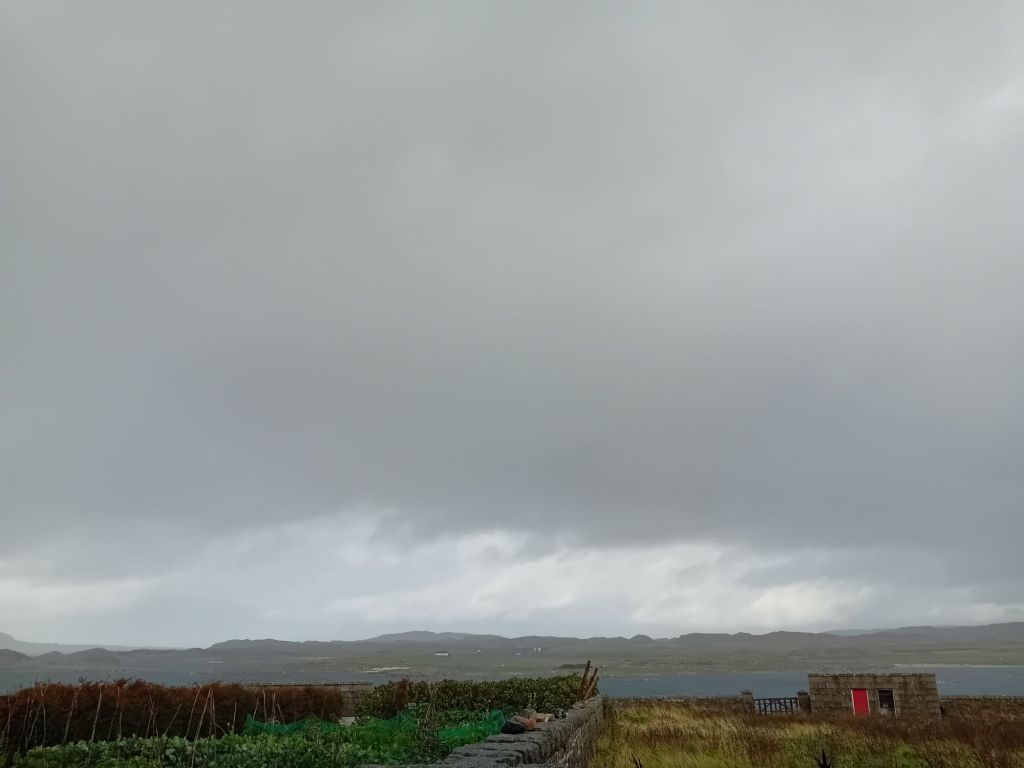
    We all crowded into Number 6 and placed lit candles around the room. It looked lovely, and we started chatting away excitedly, as though the pace of the wind had quickened our wits at the end of the day. To be sure, there were nerves too—from those who hadn’t seen the like before. This included me. We went to fetch the generator and watched the fuchsia bushes bent double at sixty degrees. The sunflowers in the kitchen garden had already fallen, as if kicked by a thoughtless lout. Coats slapped our thighs, stinging, and untied hood drawstrings flicked our eyes. No rain at that time, and mild.

    Alas, the cord on the generator dislodged, and with it our hopes of light, hot water, or sanitation. This, we learned smartly, was our introduction to the single-point-failure system we lived with. As the wood stoves heated our water, the water needed to move—otherwise it boiled in the pipes, and without the pump…

    Daylight on Saturday brought sights that could have been much worse, had it not been for the granite walls of the gardens and houses. Two of Judy’s trees at the croft were down, and her son Tom was reportedly spread-eagled on the roof of his house in the middle of the storm, trying to save his new solar panels from flying away. The purple kale and broccoli were flattened, but the polytunnels had come through unscathed. Amy hadn’t finished, though, and all through the day the winds were such that you had to really want or need to be out. Outdoor errands were brief scuttles to the communal kitchen, which became our natural meeting place as it had the only gas cooker on the island. Without any organisation, we coalesced for breakfast; porridge and coffee were made and shared as we reflected that the chances of receiving new guests were nil. Schedules went out of the still-shaking windows.

    We managed to get the generator going, and a timetable was drawn up so it could keep the freezers at temperature and, at other times, pump water for taps and loos. The compost toilets were very handy facilities, and you may never have a fresher comfort break.

    By Monday, Amy was legend, and the two guests who hadn’t cancelled were picked up and settled in. Power returned on Tuesday around 2 a.m. We were all in agreement that it had been a wonderful experience. The intimate softness of candlelight carried us into the evening with calm and sympathy for the dark outside; conversation became more introspective. There was no internet. I found myself habitually checking my phone in a pointless attempt to gain the dopamine hit I craved, before relaxing into a couple of hours with a head torch and The Steep Approach to Garbadale by Iain Banks (the first of his I’d read since being thrilled and terrified by The Wasp Factory in my early twenties).

    When the green light on the router finally came on, I was excited for all the things I’d missed. Had Nottingham Forest sacked another manager? Had people posted photos of things falling down? Granted, a few admin-type things had lapsed and needed attention, but that was all doable.

    Tuesday seemed like a good day to get things back to normal, so I pulled on my swimmers and headed down to the pier for a dip in the brown, soupy sea. I was halted by a power line lying idly on the ground, still connected on its unbroken end to the pylon. The electric company, deciding this was a decent emergency, had it back up within two hours—an amazing feat round our way.

  • It was a day

    like any other. The children, who had been on a visit, were starting their journey home—a trip of some 14 hours. The cat, who had turned up with a lame rear driver’s-side leg the day before, needed to go to the vet, and about 50 litres of solvent-based products that had been cleared from the boat shed and loaded into the minibus had to be disposed of responsibly at the recycling centre.

    We made our way onto the pier with Magnus and Shadow in his crate. Due to offshore storms there were considerable swells, which knocked our usual docking place out of action. Instead, we sailed inland and looked for the one boat ring that had not been used for years and had become as one with its surroundings. Sharp-eyed Rubi spotted it, and we tied on as the fenders tried—but failed—to stop boat meeting rock. Stepping onto wet boulders with full rucksacks and a worried-sounding cat, we shuffled along carefully. When our footing felt unsure, we passed the cat between us.

    Reaching the relative safety of the field up to Knockvologan, we passed the cat around again—its shuffling somehow made it feel heavier. Finally, we arrived at the minibus. I opened the front door and was knocked back by the concentrated cocktail of paint, white spirit, glue, marine grease, and diesel. Luckily, Ophelia needed to sort things out for a few minutes, which gave the bus some much-needed ventilation.

    With windows wide open, we set off. Petrol was low, so we stopped at the only garage for 30 miles. Robin keeps his commercial enterprise like most others on the Ross of Mull: keenly aware of his total lack of competition. Maybe this is why the fuel pumps are held together with a combination of ratchet straps and cable ties. He noticed that a tyre on the back was a bit flat but didn’t have the right attachment for his compressor, so he concluded that we’d be fine until Craignure. By this time, after being stationary for a while, the hum was strong again in the car and the cat had become subdued by the intoxicating effects of the various chemicals on board.

    It was one of those days with flashes of bright sun that lit up the mountains of the interior and their busy gullies.

    I said fond and sad goodbyes to Ophelia and Rubi, and reset the satnav for the vet, another hour away. By this time I had to keep checking on Shadow in case he was slipping into a kind of stupor. The roads were even narrower than the southern ones but less busy, thankfully. Approaching the location of the vet I looked for signage. Of course, this being remote north Mull, the vet worked out of a Luton van behind someone’s house. I had phoned to say we’d be a bit late and hoped Shadow could still be seen. Overwhelmingly glad to be out of the minibus, I was greeted by the loveliest vet, who inquired about our trip. I managed a sheepish grin and handed the patient over.

    It turned out that Shadow, who had been missing for a couple of days, had damaged his sciatic nerve—perhaps trying to extricate himself from a tight spot. He might get better, he might not, but, as the vet said, he has three crutches and a home environment free of aggressors, so a more sedentary life wouldn’t be too bad. Most importantly, he was in no pain. She also remarked that, of all the cats she had seen that day, Shadow was, by a stretch, the calmest. I couldn’t think of anything funny to say that wouldn’t have sounded concerning to someone dedicated to animal welfare.

    After being talked through the anti-inflammatory meds, it was back in the bus and on to the tip. I was told to expect dogged scrutiny by the staff. As I drove in they were leaning on a skip having a chat.
    “You know what you’re doing?” one inquired without moving.
    “Yep,” I replied, whereupon they all left the yard, presumably for lunch.

    Glad to finally be shot of my toxic cargo—apart from the black exterior paint that I couldn’t fully get off the floor—I briefly enjoyed the feeling of orientation and lucidity until I realised it was 3 p.m. and I hadn’t eaten anything all day. Luckily, The Coffee Pot at Salen was there when I most needed it. They even have a 24-hour honesty cake cupboard around the back!

    Then it was just the one-and-three-quarter-hour journey back to Erraid. I had put a blanket over the cat basket and Shadow was, mercifully, at peace.

    The final leg of the journey was no fun at all. Tired of the stop-start nature of single-track roads, I began to resent the mobile homes and the blind spots, the careless sheep, and the beauty I couldn’t properly take in for fear of driving into oblivion.

    But finally, after nearly eight hours, I made it back to Fidden, stopping to pick up 100 kg of chicken feed before meeting the boat again.

    Luckily, there was some cricket on the telly that evening. I retired early, jotting a note to myself: buy a manual tyre pump.