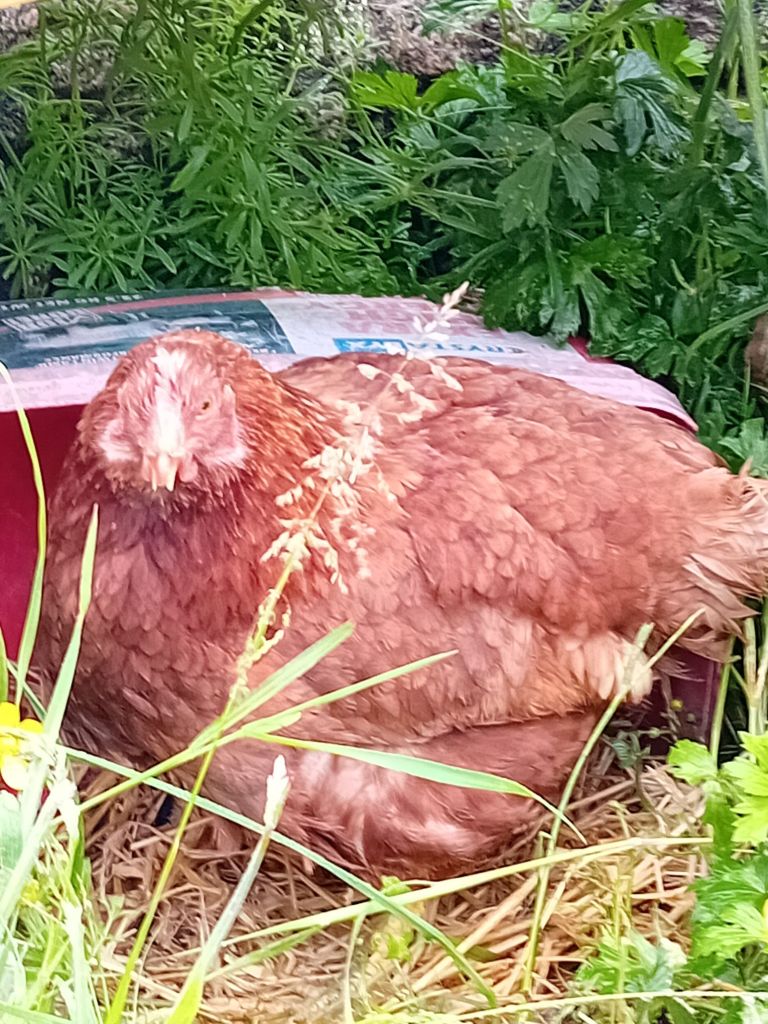
Peri is living a charmed life. As a Rhode Island Red with mobility issues, there are many lives she could have lived that would have been shorter than the one she is currently enjoying. No one is quite sure what the exact problem is, but she has a bad limp that means she can no longer scratch and forage like the other chickens. The others had taken to pecking her, seeing she was weak, so during the day she is relocated from the coop halfway down the hill to the first garden with the benches, where we have coffee breaks and meals when the weather allows. During the night, she has her own small section of the coop where she cannot be victimized.
She has split the island. When it was first discovered that she couldn’t walk properly, most assumed she would have a swift exit, but Magnus—being the most familiar with the chickens—chose to see if she would recover. The question of a visit to the vet was raised, or even a call-out, but these are remote parts—and we, the remotest part of those. Conjecture as to the opinion of a rural stock vet ran in only one direction. Quips about curry began to air, and casual bets about the longevity of Peri were taken.
The thing is, she seems to be enjoying life. Often, when an animal senses its own demise, it will withdraw and stop eating. Contrary to this, Peri seems to thrive on the hum of activity whenever drinks are taken mid-morning. With what little mobility she has left, she shuffles into the main lawn from her day box, abandoning her station next to water and cornmeal.
She has a voracious appetite. Particularly to her liking are pasta, oaten biscuits, and—as Alice found out when she was cuddling her and trying to eat dessert at the same time—spiced rhubarb cake.
There’s no doubt that Peri is lucky to be on Erraid, with its humans who try to cherish life wherever it wants to thrive. I don’t mind saying that I was a detractor at first: with so many other priorities here, what use is it to pour out meagre resources of time and energy into a chicken that will neither lay nor provide tasty meat? But Peri has taught me things that apply equally to chickens and to the people I have chosen to live with on this beautiful, austere island: if you commoditize an individual, you negate much of their potential contribution to the world. Peri has become a focus for compassion, a tool for self-forgetfulness, and a wonderful demonstration of resilience. Sure, left to fend for herself in the wild, she would have been dinner for something a long time ago. There is no question that her life has been artificially prolonged by human intervention. But she has been seen, cared for, and loved for a while. And when she settles down in her coop or box for the final time, she will not reflect or count her blessings—she’ll simply not get up again. Whereas for us larger-brained mammals, who invest huge amounts of energy developing the capacity to empathize, love, and grieve, Peri will have pecked out a little piece of Erraid folklore all for herself.


 Erraid life
Leave a reply to Adam Clark Cancel reply