Ducks. Ducks. I’m happy just saying the word several times to myself when no one’s around. It’s a matter-of-fact–sounding word that reflects well on the animals themselves. I wonder if canard has the same feeling for French people, or Ente for Germans. Perhaps the most satisfyingly onomatopoeic is pata (feminine) and pato (masculine), although the association with pâté is a bit too close.
The ducks arrived in a cardboard box from the mainland. Someone was just giving them away. Some members of the community were displeased that they were made to sit through a yoga session before the return journey to the island. We hastily rigged up a heat lamp and a small enclosure, placing them gently on the ground where they immediately huddled together under the lamp—their fluffy yellow bodies turning a pinkish red. The urge to go out and start constructing an aquatic wonderland was strong, but all they really need is an upturned bin lid with a bit of water in it so that they can clean and keep parasite-free. The byre, newly free of chickens, felt very big and dark for four small ducklings. It was agreed that they must have access to the outside as soon as practically possible.
It was at this point that summer break happened and I headed back south for a month. The thing with most ducklings is that they are yellow, and you can’t really tell how they’ll look once they get their adult feathers. So, on my return I was eager to find out what we’d got.
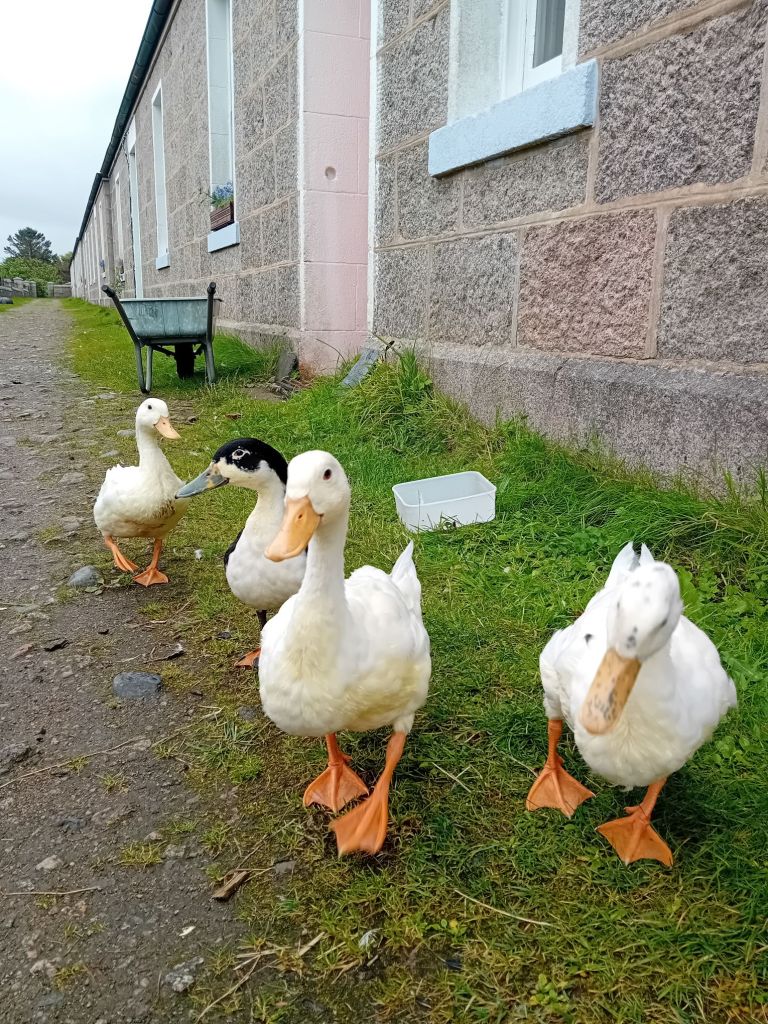
They had been moved to a paddock all of their own, with a house that used to be the privy for the lighthouse keepers and their families in Victorian times. The grass had been left to grow tall, as John the crofter takes a few bales of hay from it each year. Rubi, Ophelia, and I went on a sort of micro-safari, trying to figure out where in the paddock they might be. Their ducky mutterings gave them away in the end, and we saw them in a flattened clearing just big enough for them. Two had become almost entirely white, one was more speckled, and the other was mainly black; they were only mildly disturbed by our presence. Having made their acquaintance again, we left them in peace. At that point in their development they were just generating low-level, conversational quacks. They are now beginning to practice their adult vocalisations, which can take you by surprise if you’re close by.
They have taken to parading up and down the street. They enjoy getting into the corners where buildings meet the ground and the grass has grown longer for want of strimming. They shake their beaks furiously, burrowing them into the place where the grass meets soil—where all the bugs and slugs might be hiding. For the past couple of weeks there have been short, fierce downpours throughout the days, and the ducks make the most of the temporary puddles; they are straight in, drinking and cleaning their broad, smooth beaks that are dirty from digging. The sound of four ducks walking towards you through fresh, muddy puddles is a fantastic thing. Beatrix Potter’s description in Jemima Puddle-Duck, “pit-pat-paddle-pat, pit-pat-waddle-pat,” cannot be bettered.


 Erraid life
Leave a reply to Heath Stephenson Cancel reply